
The aerospace industry operates within a framework of uncompromising safety and performance standards. When engineers and procurement specialists look at the cabin of a modern jet, they see more than just aesthetics; they see a complex puzzle of high-performance materials and intricate geometries. Navigating the supply chain for aircraft interior parts machining presents a unique set of challenges, ranging from stringent weight reduction requirements to the absolute necessity of flame-retardant material compliance. For many manufacturers, the hurdle is not just about cutting a shape out of a block of material, but about ensuring that every aerospace cnc part meets the tight tolerances required for seamless integration into the aircraft’s airframe.
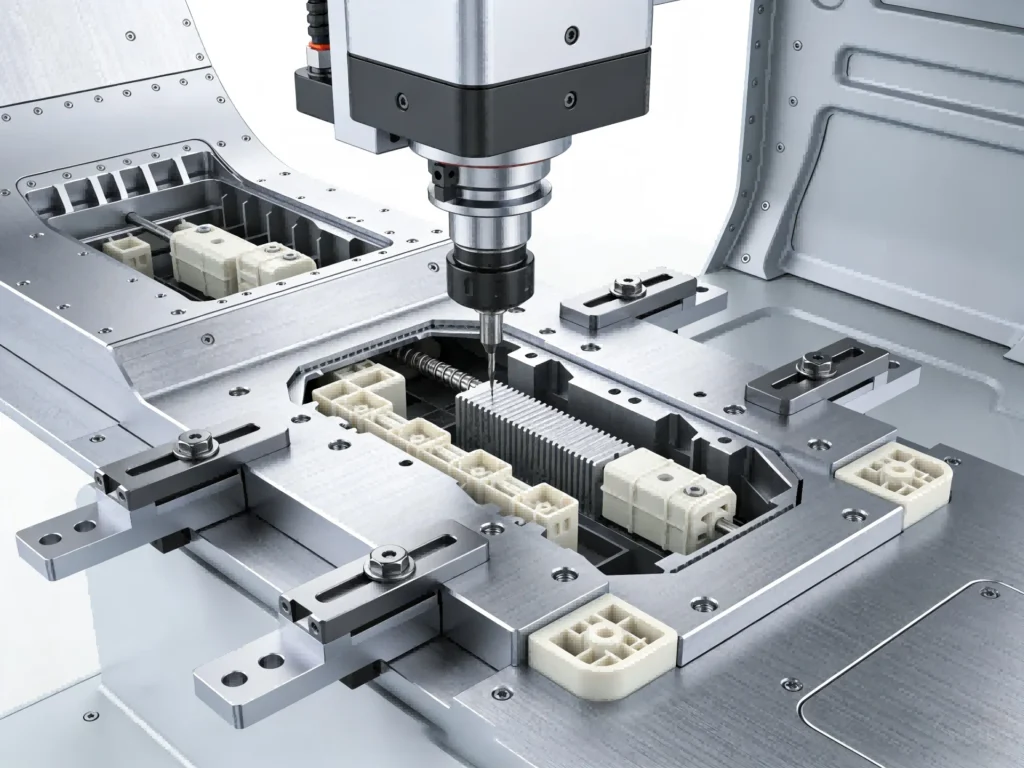 aircraft interior parts machining serves as the ultimate solution. By leveraging advanced CNC technology, manufacturers may produce components that are both incredibly lightweight and structurally sound, addressing the core concerns of modern aviation design.
The Core Solution: What is Aircraft Interior Parts Machining?
At its fundamental level, aircraft interior parts machining is a specialized subtractive manufacturing process used to create the components that make up the “cabin experience” and “cockpit infrastructure.” Unlike standard industrial machining, this process often involves working with exotic polymers and high-grade aluminum alloys that require specific thermal management and toolpath strategies. The principle relies on Computer Numerical Control (CNC) systems that translate digital CAD designs into physical reality with micron-level accuracy.
In the context of interior aerospace applications, the process must account for the mechanical properties of the materials used. For instance, machining high-performance plastics like PEEK or Ultem requires an understanding of how these materials react to heat during the cutting process. If the temperature rises too high, the material could warp, leading to a part that does not fit the assembly. Therefore, the solution involves not just the machine itself, but the expertise of the operator and the sophistication of the programming to maintain dimensional stability.
Key Materials and Their Role
The choice of material is perhaps the most critical factor in the success of aircraft components parts. Engineers often choose between several categories based on the specific application within the cabin:
- Aluminum Alloys (e.g., 6061, 7075): Frequently used for structural brackets and seat frames due to their high strength-to-weight ratio.
- High-Performance Plastics (e.g., PEEK, Torlon, Ultem): Preferred for non-structural interior components because they are lightweight and inherently flame-retardant.
- Composite Substrates: Used in modern flooring and wall panels, often requiring specialized diamond-tipped tooling to machine without fraying the fibers.
Strategic Application: Where Precision Meets the Passenger
The application of aircraft interior parts machining is far-reaching. It is not limited to what the passenger sees but extends to the hidden mechanisms that ensure the aircraft functions safely. When considering the aircraft parts india market or the global manufacturing landscape, the focus is often on these critical application zones:
1. Seating and Passenger Comfort Structures
Modern seating is an engineering marvel. CNC machining is used to create the complex reclining mechanisms, tray table arms, and seat-back entertainment enclosures. These aircraft components parts must be smooth to the touch (to avoid snagging clothing) yet strong enough to withstand the forces of a hard landing. Machining allows for the integration of aesthetic curves and ergonomic designs that injection molding might struggle to achieve at lower production volumes.
2. Cockpit and Avionics Housing
The cockpit is the brain of the aircraft. Here, aerospace cnc part production focuses on instrument panels, control yokes, and housing for sensitive electronics. These parts require electromagnetic interference (EMI) shielding and perfect fitment to ensure that pilots have reliable access to controls during critical phases of flight.
3. Galley and Lavatory Hardware
Galley inserts, locking mechanisms for overhead bins, and lavatory fixtures are often subjected to high-frequency use. Interior aerospace hardware must be corrosion-resistant and easy to clean, often leading to the use of anodized aluminum or specialized stainless steels that are machined to high surface finishes.
To better understand the various manufacturing choices, consider the following comparison table which highlights why CNC machining remains the preferred choice for many interior components compared to alternative methods.
| Feature | CNC Machining | Injection Molding | 3D Printing (Additive) |
|---|---|---|---|
| Material Versatility | High (Metals, Plastics, Composites) | Medium (Mostly Thermoplastics) | Medium (Specific Resins/Filaments) |
| Initial Tooling Cost | Low to Medium | Extremely High | Very Low |
| Surface Finish | Excellent (Ra 0.8 or better) | Good | Poor to Medium (Requires Post-processing) |
| Tolerance Levels | ±0.005mm to ±0.025mm | ±0.1mm to ±0.2mm | ±0.1mm to ±0.3mm |
| Best For | Custom, Low-to-Mid Volume, High Precision | Mass Production, Simple Geometries | Prototyping, Complex Internal Geometries |
Navigating the Selection: Key Factors in Buying Aerospace Parts
When searching for aircraft parts manufacturers in india or any global partner, the decision-making process must be rigorous. A failure in the selection process could lead to costly delays or, worse, safety non-compliance. Here are the factors that should guide your selection:
Certifications and Quality Management
The first question any procurement officer should ask is about certifications. AS9100 Rev D is the gold standard for aerospace quality management. It ensures that the manufacturer has a robust system for traceability, risk management, and process control. Without this, the aircraft interior parts machining provider cannot guarantee that the materials used are authentic or that the processes are repeatable.
Precision and Capability
Can the shop handle 5-axis machining? Many interior aerospace components have complex, organic shapes that are difficult to reach with standard 3-axis mills. A 5-axis capability allows for the machining of a part in a single setup, which significantly reduces the margin for error that occurs when a part is moved between multiple fixtures.
Material Traceability
In the aerospace world, a part is only as good as its paperwork. Every block of raw material should come with a Certificate of Analysis (COA). Aircraft components parts must be traceable back to the original heat lot of the metal or the batch of the polymer. This level of transparency is essential for accident investigation and long-term maintenance tracking.
Lead Times and Supply Chain Resilience
In the post-pandemic landscape, lead times have become a major pain point. Evaluating aircraft parts india suppliers or international vendors requires a look at their inventory management. Do they stock common aerospace alloys? Do they have redundant power systems or multiple machining centers to ensure production doesn’t stop if one machine fails?
Maintenance and Longevity of Machined Interior Parts
Once aircraft interior parts machining is complete and the parts are installed, their lifecycle management begins. Maintenance is relatively straightforward but requires diligence. Because many interior parts are made of polymers, they may be sensitive to certain harsh cleaning chemicals. Maintenance manuals should specify pH-neutral cleaners to avoid stress cracking in plastic aerospace cnc part assemblies.
For metal components, regular inspections for fatigue or corrosion are vital. Even though interior parts are not exposed to the external atmosphere, humidity and temperature fluctuations within the cabin can lead to oxidation over several years. Anodizing or powder coating during the manufacturing phase can significantly extend the life of these parts.
Why Jucheng is the Strategic Partner for Your Aerospace Needs
Choosing a partner like jucheng for aircraft interior parts machining means choosing a legacy of precision and a commitment to innovation. At jucheng, we understand that the aerospace sector doesn’t just need a vendor; it needs a technical ally. Our facility at https://www.jccncmachining.com/ is equipped with the latest CNC technology designed to handle the rigorous demands of the aviation industry.
Technical Excellence and Equipment
Jucheng utilizes multi-axis CNC machines that provide the versatility needed for the most complex interior aerospace designs. Our focus on high-speed machining ensures that we can maintain tight tolerances while keeping production costs competitive. We have invested in metrology equipment, including CMM (Coordinate Measuring Machines), to verify that every aerospace cnc part leaving our floor is identical to the digital blueprint.
Global Reach with a Focus on Quality
Whether you are looking for aircraft parts manufacturers in india or looking to diversify your supply chain globally, jucheng offers the scale and reliability required. We provide full material certification and process documentation, ensuring that your quality assurance team has everything they need for compliance audits. Our expertise in machining lightweight materials directly addresses the industry’s drive toward sustainability and fuel efficiency.
Customization and Prototyping
The aviation industry is shifting toward more personalized cabin experiences, especially in business jets and first-class cabins. Jucheng excels in small-batch production and rapid prototyping. We can help you take a concept from a napkin sketch to a flight-ready aircraft components parts assembly in a fraction of the time it takes traditional manufacturers.
Frequently Asked Questions About Aerospace Machining
What are the most common tolerances for aircraft interior parts?
Typically, aircraft interior parts machining requires tolerances ranging from ±0.1mm for general trim components to ±0.01mm for critical mechanical linkages and locking mechanisms. The tighter the tolerance, the more specialized the tooling and inspection process must be.
Why is weight so important in interior aerospace design?
Every kilogram added to an aircraft increases the fuel burn over the thousands of flight hours in its lifespan. By using CNC machining to “pocket out” unnecessary material (lightweighting), manufacturers can maintain structural integrity while significantly reducing the overall weight of the aerospace cnc part.
Does Jucheng provide surface finishing for aerospace parts?
Yes, at jucheng, we offer a variety of finishes, including bead blasting, anodizing, and chemical film coatings. These finishes are crucial for both the aesthetic appeal of interior aerospace components and their resistance to wear and tear.
Can you machine flame-retardant plastics?
Absolutely. Machining materials like Ultem 9085 or PEEK is a core part of our aircraft interior parts machining service. These materials are difficult to machine because they are abrasive and heat-sensitive, but our specialized tooling and cooling strategies ensure a high-quality finish every time.
How does Jucheng ensure the quality of aircraft parts india and global orders?
We implement a strict multi-stage inspection process. This includes raw material verification, in-process monitoring, and final 100% inspection of critical dimensions. Our digital tracking system ensures that all documentation is accurate and readily available for our international clients.
What is the typical lead time for a custom aerospace cnc part?
Lead times vary based on complexity and material availability. However, for most aircraft components parts, jucheng aims for a turnaround of 2 to 4 weeks. We also offer expedited services for AOG (Aircraft on Ground) situations or urgent prototyping needs.
Are CNC machined parts better than 3D printed parts for aircraft interiors?
While 3D printing is great for complex internal shapes, aircraft interior parts machining typically offers superior surface finish, better mechanical properties, and higher dimensional accuracy. For parts that require high strength and a “class-A” aesthetic finish, CNC is the industry standard.
Conclusion: Elevate Your Aerospace Projects with Precision
The path to a successful aerospace project is paved with precision. By addressing the common pitfalls of material selection, certification, and dimensional accuracy, aircraft interior parts machining provides the reliable foundation that modern aviation demands. Whether you are a buyer looking for aircraft parts manufacturers in india or a designer needing a complex aerospace cnc part, the focus must always remain on quality and compliance.
Ready to take your aerospace components to the next level? Jucheng is here to help you navigate the complexities of interior aerospace manufacturing. With our advanced capabilities and commitment to excellence, we turn your most challenging designs into reality. Visit https://www.jccncmachining.com/ today to request a quote and see how our expertise can streamline your supply chain and enhance your product quality.