
The wrong transition creates two bills: one for tooling and another for machining features the casting cannot reliably hold. The right transition divides the part into as-cast geometry and precision-machined interfaces before the die is released. This article evaluates that boundary through lifecycle cost, geometry, porosity risk, tolerance allocation, and production evidence.
The Transition Question Buyers Should Ask
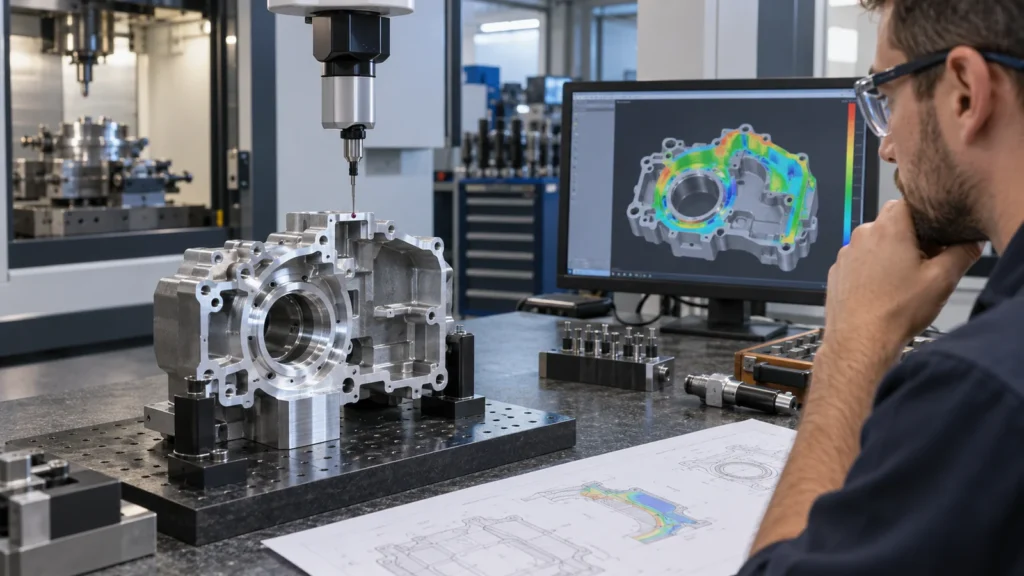 “At what quantity is die casting cheaper?” sounds precise but omits the variables that determine the answer. A thick rectangular block with many critical pockets may remain machining-intensive even after casting. A thin-ribbed housing with bosses and complex outer form may gain much more from a die. The useful question is: how much of the final geometry can the casting create acceptably, and what work remains after ejection?
Start by separating geometry into three groups: features the die can form and release; features the die can form but cannot hold to final functional requirements; and features that still require drilling, milling, reaming, tapping, or finishing. This map reveals whether tooling removes substantial recurring work or merely adds a casting step before nearly the same machining route.
“At what quantity is die casting cheaper?” sounds precise but omits the variables that determine the answer. A thick rectangular block with many critical pockets may remain machining-intensive even after casting. A thin-ribbed housing with bosses and complex outer form may gain much more from a die. The useful question is: how much of the final geometry can the casting create acceptably, and what work remains after ejection?
Start by separating geometry into three groups: features the die can form and release; features the die can form but cannot hold to final functional requirements; and features that still require drilling, milling, reaming, tapping, or finishing. This map reveals whether tooling removes substantial recurring work or merely adds a casting step before nearly the same machining route.
Build a Lifecycle Cost Model
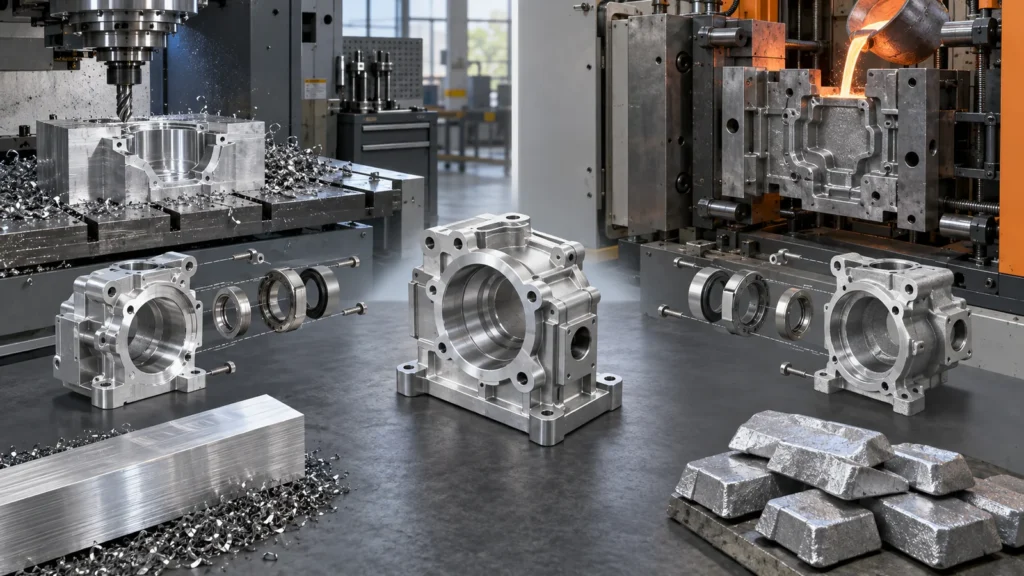 CNC cost includes stock, programming, setups, cutting time, tools, inspection, finishing, and recurring scrap exposure. Die casting adds die design and manufacture, trial runs, revisions, process development, maintenance, casting scrap, trimming, deburring, leak or integrity testing where required, and secondary machining. Freight and inventory behavior may also change because economical casting batches can be larger than immediate demand.
A simple crossover calculation is useful only after the quoted scopes match. Use expected lifetime quantity, not an optimistic annual forecast. Include the probability and cost of engineering changes. If the product may change before the tool amortizes, the apparent unit-cost saving can disappear.
CNC cost includes stock, programming, setups, cutting time, tools, inspection, finishing, and recurring scrap exposure. Die casting adds die design and manufacture, trial runs, revisions, process development, maintenance, casting scrap, trimming, deburring, leak or integrity testing where required, and secondary machining. Freight and inventory behavior may also change because economical casting batches can be larger than immediate demand.
A simple crossover calculation is useful only after the quoted scopes match. Use expected lifetime quantity, not an optimistic annual forecast. Include the probability and cost of engineering changes. If the product may change before the tool amortizes, the apparent unit-cost saving can disappear.
A Casting Needs a Different Geometry Language
Billet machining rewards tool access, rigid workholding, practical corner radii, and reduced setup count. Die casting adds parting direction, draft, wall consistency, fillets, ejector access, gate and overflow locations, slide actions, and metal-flow considerations. A machined pocket can be deep and locally thick; a casting may perform better when mass is redistributed into walls, ribs, and bosses.
Do not send a mature CNC model to a foundry and ask for a direct conversion. First identify functional envelopes, protected interfaces, load paths, and regions that may be reshaped. The casting supplier can then reduce hot spots and improve release without moving the features that control assembly.
Machining allowance is part of the casting design. Critical faces need enough stock to clean up despite cast variation, but excess allowance adds cutting time and may expose porosity. Datum pads and locating features must let the irregular near-net blank be held consistently for secondary operations.
Material Integrity Is Not a Slogan
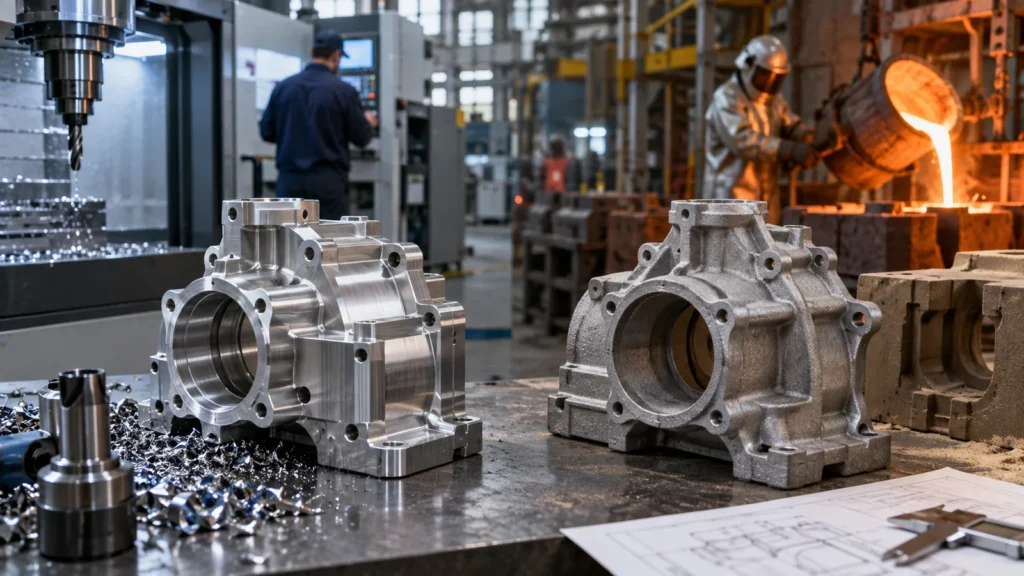 “Billet is stronger” and “castings are good enough” are both incomplete statements. Performance depends on alloy, stock condition, casting process, section thickness, porosity, heat treatment, loading, fatigue, sealing duty, and quality control. A casting alloy may be selected for fill and process stability rather than to duplicate a familiar wrought alloy.
Pressure-tight housings, structural mounts, threaded bosses, and thin sealing walls need application-specific review. If porosity could intersect a machined seal, bore, or thread, the risk belongs in design and process planning—not only in final inspection. Requirements may include leak testing, X-ray or other examination, impregnation policy, cut-up studies, or defined acceptance criteria, depending on the program.
Prototype evidence must be labeled honestly. A billet prototype can validate geometry and many interfaces, but it does not prove casting fill, porosity behavior, ejection, or cast material properties. Conversely, an early casting should not be rejected against billet behavior unless the production requirement actually demands that behavior.
“Billet is stronger” and “castings are good enough” are both incomplete statements. Performance depends on alloy, stock condition, casting process, section thickness, porosity, heat treatment, loading, fatigue, sealing duty, and quality control. A casting alloy may be selected for fill and process stability rather than to duplicate a familiar wrought alloy.
Pressure-tight housings, structural mounts, threaded bosses, and thin sealing walls need application-specific review. If porosity could intersect a machined seal, bore, or thread, the risk belongs in design and process planning—not only in final inspection. Requirements may include leak testing, X-ray or other examination, impregnation policy, cut-up studies, or defined acceptance criteria, depending on the program.
Prototype evidence must be labeled honestly. A billet prototype can validate geometry and many interfaces, but it does not prove casting fill, porosity behavior, ejection, or cast material properties. Conversely, an early casting should not be rejected against billet behavior unless the production requirement actually demands that behavior.
Map Precision Instead of Demanding It Everywhere
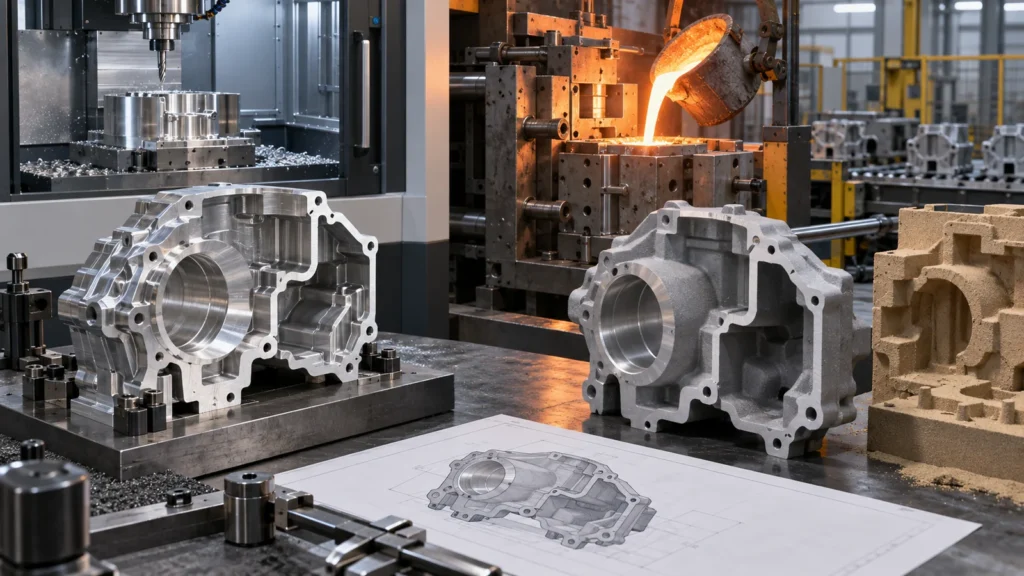 Use a color-coded feature map. One color marks surfaces acceptable as cast. A second marks cast features needing broad positional or envelope control. A third marks interfaces that must be machined: bearing bores, sealing lands, datum faces, threaded ports, connector seats, or precision hole patterns. This prevents unnecessary machining of cosmetic areas and unrealistic tolerance on free cast surfaces.
The drawing should distinguish pre-machining and final conditions. Datum references must support both casting inspection and machining setup. If a machined face removes the original cast datum, the inspection sequence needs another stable reference. Surface treatment and masking should also be included because they can change fits, conductivity, sealing, and cosmetic zones.
For machined interfaces, the principles in CNC machining tolerance planning still apply. The difference is that workholding and stock allowance begin with a variable casting rather than uniform bar or plate.
Use a color-coded feature map. One color marks surfaces acceptable as cast. A second marks cast features needing broad positional or envelope control. A third marks interfaces that must be machined: bearing bores, sealing lands, datum faces, threaded ports, connector seats, or precision hole patterns. This prevents unnecessary machining of cosmetic areas and unrealistic tolerance on free cast surfaces.
The drawing should distinguish pre-machining and final conditions. Datum references must support both casting inspection and machining setup. If a machined face removes the original cast datum, the inspection sequence needs another stable reference. Surface treatment and masking should also be included because they can change fits, conductivity, sealing, and cosmetic zones.
For machined interfaces, the principles in CNC machining tolerance planning still apply. The difference is that workholding and stock allowance begin with a variable casting rather than uniform bar or plate.
From Billet Prototype to Cast Production Without Losing Intent
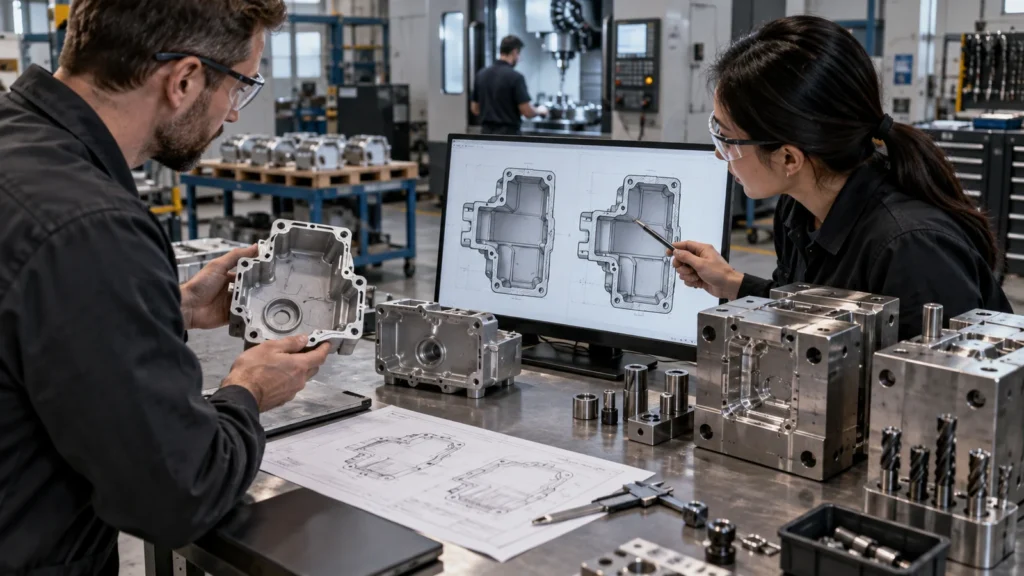
This handoff is a project, not a purchase-order note. The broader CNC prototyping and production framework helps preserve revision, test, and inspection evidence while the primary forming route changes.
Three-Route Scorecard: Billet, Casting, or Hybrid
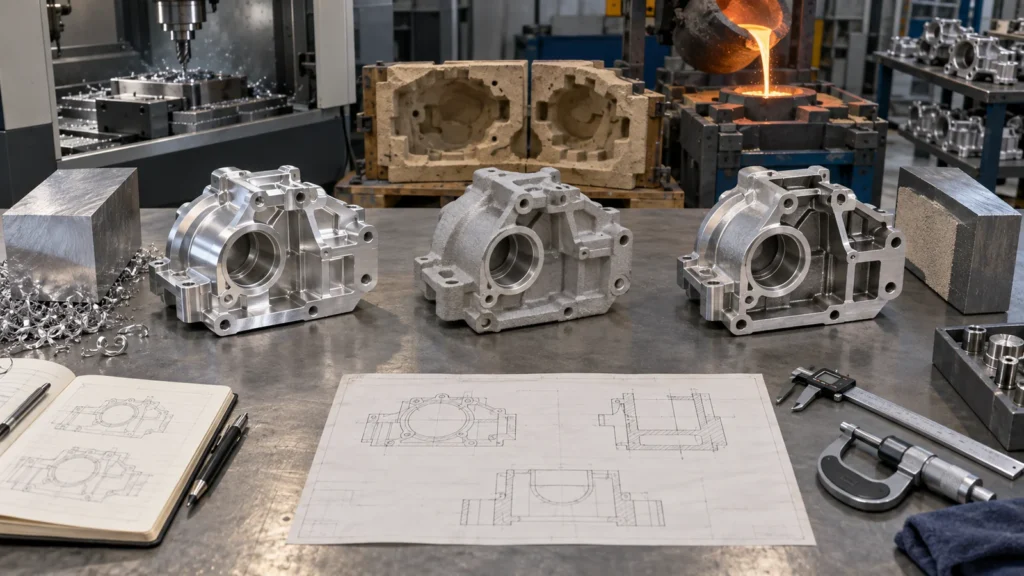
What Suppliers Need to Compare Routes
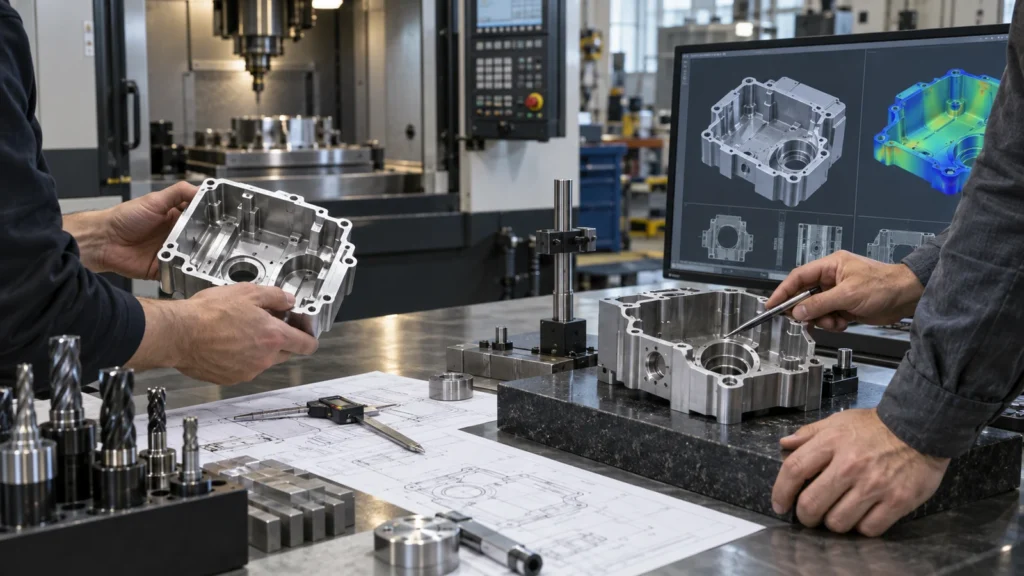 Provide the 3D model, controlled drawing, target volumes by release, expected product life, alloy requirements, critical characteristics, pressure or structural duty, surface finish, inspection records, and change outlook. Ask each supplier to state assumptions about tooling ownership, die life, maintenance, cavities, process scrap, machining allowance, secondary operations, testing, and packaging.
For a reliable comparison, keep the acceptance definition constant while allowing the manufacturing design to change. That reveals where the advantages and disadvantages of CNC machining truly matter and where a near-net casting can remove recurring work.
Provide the 3D model, controlled drawing, target volumes by release, expected product life, alloy requirements, critical characteristics, pressure or structural duty, surface finish, inspection records, and change outlook. Ask each supplier to state assumptions about tooling ownership, die life, maintenance, cavities, process scrap, machining allowance, secondary operations, testing, and packaging.
For a reliable comparison, keep the acceptance definition constant while allowing the manufacturing design to change. That reveals where the advantages and disadvantages of CNC machining truly matter and where a near-net casting can remove recurring work.
Require a responsibility matrix when the foundry, machine shop, finisher, and test provider are different companies. It should identify the owner of material certificates, cast-lot traceability, incoming acceptance, machining scrap, leak-test failures, coating defects, final dimensional release, and nonconformance decisions. Without this map, each supplier can meet its local specification while the completed housing still fails.
Finished-part yield is more meaningful than casting yield alone. A casting may appear acceptable until machining opens a pore at a seal face or thread. That late failure has already consumed transport, cutting, finishing, and inspection. Agree how the loss is recorded, who pays for it, and what recurring evidence triggers corrective action.
Capacity assumptions also need review. The casting cell may produce bodies faster than the secondary machining line can finish them. Model the constrained operation, changeover time, buffer inventory, and inspection throughput so the chosen route supports delivery as well as piece cost.
Finally, request change-control timing. A modified port, wall, boss, or gasket path may affect die steel, flow balance, ejector layout, machining fixtures, gauges, and inspection programs. Understanding that chain before tooling release is often more valuable than negotiating a small reduction in first quoted unit price.
Decision FAQs
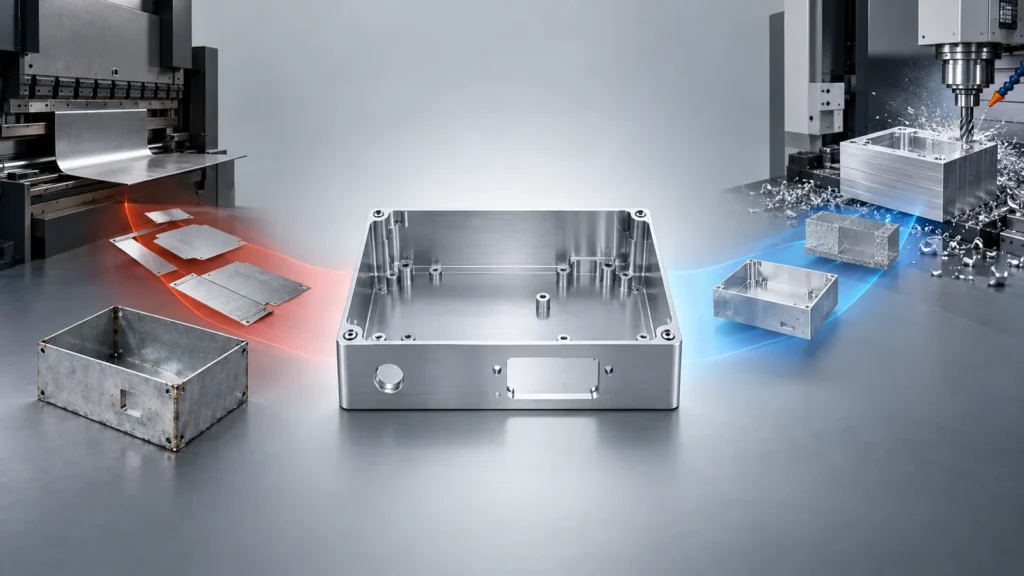
Sometimes, but many functional components still need machined bores, sealing faces, threads, datums, or hole patterns. The answer depends on the casting capability and the feature-level requirements, not the general process name.
Should a billet prototype use the exact die-casting alloy?
Not necessarily, and often the equivalent stock form is unavailable. Select a prototype material based on what the test must prove, then document property differences and repeat process-sensitive tests on cast samples.
What makes a CNC-designed housing difficult to cast?
Local thick masses, missing draft, inaccessible undercuts, abrupt wall transitions, poor ejection access, and geometry that ignores gate and overflow needs are common obstacles. A casting redesign should protect function while changing noncritical volume distribution.
Who owns the final dimensional result on a hybrid part?
The supply agreement should make responsibility explicit. One integrated supplier simplifies accountability; with separate foundry and machine shop sources, define casting allowance, datum condition, incoming acceptance, and disposition rules before production.