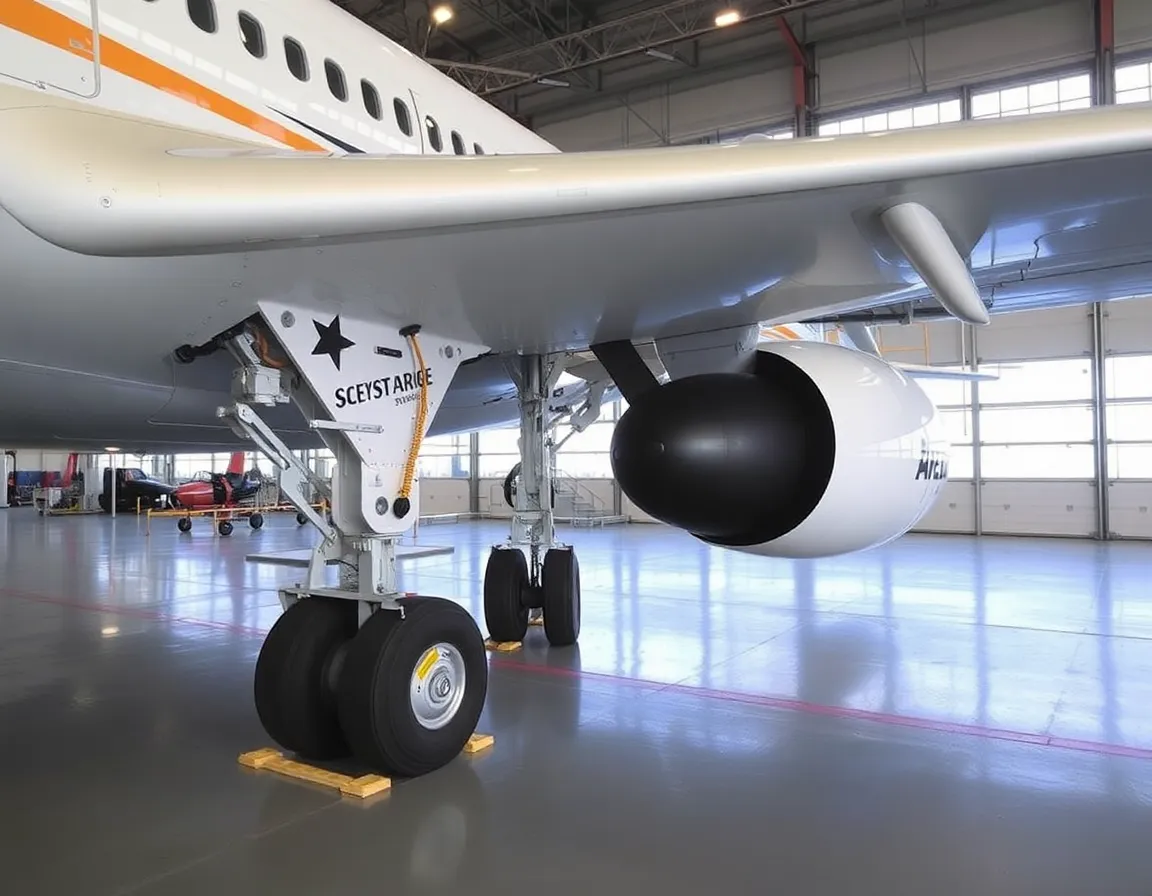
The landing gear, often called the undercarriage, is far more than just the wheels of an aircraft. It is a complex, mission-critical system that bears the immense forces of takeoff, supports the entire weight of the aircraft on the ground, and absorbs the tremendous impact energy during landing. Understanding its key components is essential to appreciating the engineering marvel that ensures every flight concludes safely. This article delves into the essential parts of a typical landing gear assembly, explaining their functions and importance in the aviation ecosystem.
The Main Structural Components
This group forms the backbone of the landing gear, providing the primary strength and structure necessary to handle massive loads. These parts are designed for durability and resilience.
Shock Strut (Oleo Strut)
The shock strut is the heart of the landing gear's energy absorption system. Its primary function is to dampen the impact forces during landing and smooth out bumps during taxiing. Most modern aircraft use an oleo-pneumatic shock strut, which combines a hydraulic fluid and compressed nitrogen or air. Upon impact, the piston is forced into the cylinder, compressing the gas and forcing fluid through a metering pin or small orifice. This process converts the kinetic energy of the landing into heat energy, which is dissipated, providing a controlled and smooth deceleration.
Main Fitting and Trunnion
The main fitting is the central hub that connects the shock strut to the aircraft's primary structure, typically a strong wing or fuselage spar. The trunnion is a pivotal part of this assembly—a cylindrical projection on the shock strut that rotates within bearings in the main fitting. This rotation is what allows the gear to swing from its stowed position in the fuselage or wing to its extended, locked position for landing. This joint must withstand incredible shear and bending moments.
Torque Links (Scissor Links)
These are a pair of hinged links connecting the moving piston to the outer cylinder of the shock strut. They have two vital functions:
- Alignment: They prevent the piston from rotating out of alignment, ensuring the wheels remain oriented correctly.
- Extension Limitation: They physically limit how far the shock strut can extend, holding it in the correct position for taxiing and ensuring it doesn't over-extend when the aircraft lifts off.
The Retraction and Locking System
To reduce aerodynamic drag in flight, most aircraft (except many small trainers) are equipped with retractable landing gear. This system is a marvel of mechanical, hydraulic, and electrical integration.
Actuators
These are the muscles of the system, providing the force to move the heavy gear. Hydraulic actuators are most common on larger aircraft, using pressurized fluid to drive a piston. Some smaller aircraft use electrical screw-jack actuators. These components must be incredibly reliable, as a failure can lead to a gear-up landing or an unsafe gear condition.
Uplocks and Downlocks
These are positive mechanical locking devices that are crucial for safety.
- Uplocks secure the gear in the retracted position during flight, preventing it from accidentally free-falling due to gravity or vibration.
- Downlocks hold the gear firmly in the extended and locked position for landing and taxiing. They often incorporate a mechanical over-center linkage that must be positively unlocked by the retraction system before the gear can move.
These locks are often supplemented by safety pins ("remove before flight" flags) used during ground maintenance to physically prevent accidental retraction.
Doors and Sequencers
Landing gear doors streamline the aircraft when the gear is retracted. A sequencing system—controlled by mechanical linkages, valves, or software—ensures the doors open before the gear extends or retracts, and close afterward. This prevents the gear from striking the doors, which could cause catastrophic damage.
Wheels, Brakes, and Steering
This subsystem interfaces directly with the runway, providing mobility, deceleration, and directional control on the ground.
Wheels, Tires, and Tubes
Aircraft wheels are typically lightweight, high-strength magnesium or aluminum alloy assemblies designed to handle high speeds and loads. Tires are reinforced with multiple layers of cord (ply) and are inflated to high pressures. They are often tubeless on larger aircraft. Key features include:
- Deep Tread: For water dispersion to prevent hydroplaning.
- Fusible Plugs: Safety devices that melt at a specific temperature, deflating a tire before overheat causes a explosive failure.
- Multiple Wheels: Used on heavy aircraft to distribute weight and provide redundancy.
Braking System
Aircraft brakes are multi-disc, hydraulically actuated systems mounted on the axle inside the wheel. Carbon composite brakes are standard on modern jets due to their high heat capacity and light weight. The system includes:
- Brake Assemblies: Stacks of alternating stator and rotor discs.
- Anti-skid Systems: Critical electronic systems that prevent wheel lock-up during heavy braking, modulating pressure to maintain optimal deceleration and tire integrity.
- Auto-brakes: A system that automatically applies pre-selected brake pressure upon landing, reducing pilot workload.
Steering Systems
While small aircraft use simple mechanical linkages or differential braking for ground steering, larger aircraft require powered systems.
- Nose Wheel Steering: Controlled by the pilot's tiller or rudder pedals, it uses hydraulic actuators to turn the nose gear. It often has two ranges: a small angle for taxiing via rudder pedals and a large angle for tight turns via a separate tiller.
- Main Gear Steering: Some very large aircraft (like the Boeing 777) have steerable body gears to reduce turning radius and tire scrubbing.
Ancillary and Safety Components
These parts support the core systems, providing vital information and backup safety functions.
Position and Warning Systems
This network of sensors and indicators informs the crew of the gear's status. It includes:
- Microswitches/Sensors: Detect whether the gear is up and locked, or down and locked.
- Position Lights: Green lights indicate "down and locked"; red or amber lights indicate an unsafe condition.
- Landing Gear Warning Horn: Sounds if the throttle is reduced and the gear is not down and locked, a critical safety alert.
Alternate Extension Systems
In case of a primary system failure (e.g., hydraulic loss), aircraft are equipped with backup methods to lower the gear. These can include:
- Gravity Free-Fall: Releasing the uplocks allows the gear to fall and lock under its own weight and airflow.
- Manual Crank Systems: A hand crank in the cockpit to mechanically drive the gear down.
- Emergency Hydraulic/Air Bottles: A separate pressurized reservoir to power the actuators.
Shimmy Dampers
This is a small but crucial device attached to the nose gear. It prevents shimmy—a violent, uncontrolled oscillation of the nose wheel that can cause severe structural damage. It acts as a viscous damper, absorbing the energy of the oscillation.
Best Practices in Maintenance and Operation
The complexity of landing gear demands rigorous adherence to best practices. Preventive maintenance is paramount, following strict manufacturer and regulatory guidelines. This includes regular inspections for cracks, corrosion, and wear; checking oleo strut inflation and fluid leaks; testing retraction cycles; and measuring brake wear. For pilots, proper operation includes performing a thorough pre-flight inspection of the gear, adhering to crosswind and maximum landing weight limits, and using smooth control inputs during taxi, takeoff, and landing to minimize stress. Understanding the function of each component fosters a deeper respect for the system and underscores the importance of meticulous care for this fundamental guarantor of flight safety.
In conclusion, the landing gear is a symphony of mechanical, hydraulic, and electrical parts working in perfect harmony. From the energy-absorbing shock strut to the life-saving anti-skid brakes and the reliable locking mechanisms, each component plays an indispensable role. It is a system where redundancy and robustness are engineered into every joint and circuit, ensuring that after every journey through the skies, an aircraft can confidently and safely return to earth.