Beyond the Grip: The Art and Engineering of Knurling
In a world of sleek, polished surfaces, a tactile, textured pattern stands out for its sheer utility and unmistakable character. This is the domain of knurling, a manufacturing process as functional as it is visually distinct. Far more than a simple aesthetic choice, knurling is a critical engineering solution for grip, handling, and mechanical function. A professional knurling service transforms a smooth metal workpiece—be it a simple thumb screw or a complex aerospace component—into a part that can be securely handled, precisely adjusted, or permanently joined. This article delves into the intricacies of knurling, explaining its mechanisms, varieties, applications, and the key considerations for leveraging a professional service to master this essential technique.
What is Knurling? A Definition in Texture
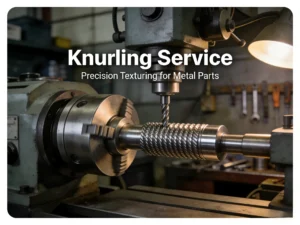
Knurling is a manufacturing process that imparts a patterned texture onto the surface of a workpiece, typically metal but also applicable to plastics and other materials. This is achieved by pressing a hardened tool, called a knurl, with a specific pattern of raised teeth against the rotating workpiece. The pressure causes a displacement and flow of the material, creating a corresponding raised diamond or straight-line pattern. Unlike machining which removes material, traditional knurling is primarily a cold-forming process, displacing the surface to create the pattern without significant chip generation.
The primary purposes are threefold: to enhance grip for human hands or tools, to increase the diameter for a press fit, and to improve aesthetics. The resulting texture provides a secure, non-slip surface that is invaluable in countless applications, from the humble workshop vise handle to sophisticated medical devices.
How the Process Works: Tools and Techniques
Knurling is most commonly performed on lathes, milling machines, or dedicated knurling tools. The two predominant methods are:
- Cut Knurling: This method uses a tool that actively cuts the pattern into the material, removing chips similar to a threading tool. It is ideal for hard materials, thin-walled parts, or applications where precise dimensional control is critical, as it generates less radial force.
- Form Knurling: The traditional method where two or three hardened wheels are pressed against the workpiece. The material is deformed (formed) into the pattern. This is faster and creates a stronger, work-hardened surface but exerts significant radial force on the part and machine.
A professional knurling service will select the appropriate method based on the material specifications, part geometry, and final application requirements, ensuring optimal results without compromising the part's integrity.
The Knurling Lexicon: Patterns, Pitches, and Styles
Not all knurled textures are created equal. The pattern, pitch, and style determine both the function and the final appearance of the part.
Primary Patterns
- Diamond Knurl: The most recognizable pattern, featuring a crisscrossed grid of raised diamonds. It offers excellent multi-directional grip and is the most common choice for hand tools, knobs, and grips.
- Straight Knurl (Linear): Comprises parallel lines running along the axis of the part. It provides grip in a primarily linear or twisting motion and is often used for thumb screws, adjustment collars, and as a decorative element.
- Concave & Convex Knurl: Specialized patterns applied to curved surfaces. Concave knurling follows the inward curve of a part, while convex follows an outward curve, maintaining consistent grip on non-cylindrical surfaces.
Pitch and Coarseness
The pitch refers to the number of teeth per inch (TPI) or the distance between rows. A coarse knurl (low TPI, e.g., 10-20) provides an aggressive, deep grip for heavy-duty applications. A fine knurl (high TPI, e.g., 30-40) offers a more refined, comfortable grip for precision instruments or aesthetic detailing. The choice impacts both feel and function.
Why Knurl? The Multifaceted Benefits
Engaging a professional knurling service delivers a suite of advantages that extend well beyond simple texture.
- Unmatched Functional Grip: The primary benefit. In high-stress, oily, or wet environments, a knurled surface ensures tools and components can be manipulated safely and securely, reducing slippage and improving operator control and safety.
- Enhanced Mechanical Function: Knurling is used to create a "press fit" between two components. By slightly increasing the diameter of a shaft, knurling creates a strong, interference fit when pressed into a bore, often eliminating the need for pins, keys, or adhesives.
- Ergonomic Improvement: A well-designed knurl reduces hand fatigue by distributing pressure and minimizing the force needed to maintain a secure hold, crucial for hand tools used over extended periods.
- Durability and Wear Resistance: The cold-forming process work-hardens the surface of the material, making it more resistant to abrasion and wear than the original substrate.
- Aesthetic Branding and Identity: A custom knurl pattern can become a signature element of a product line, conveying quality, precision, and a tactile user experience that distinguishes a brand in the marketplace.
Applications Across Industries: Where Knurling Excels
The utility of knurling ensures its presence in nearly every engineering and consumer field.
- Tooling & Industrial: Vise handles, wrench heads, drill press handles, lathe wheels, and gauges all rely on knurling for secure operation.
- Aerospace & Defense: Used on flight control knobs, weapon components, and access panels where positive grip is essential, often with strict specifications for pattern and depth.
- Automotive: Found on gear shift knobs, adjustment screws for carburetors, brake adjusters, and custom automotive accessories.
- Medical Devices: Critical for the fine, precise adjustment of surgical tools, microscopes, and diagnostic equipment where gloved hands must maintain control.
- Consumer Electronics & Hardware: Camera lens barrels, premium pen grips, flashlight bodies, door handles, and furniture adjusters use knurling for both function and high-end appeal.
Best Practices for a Successful Knurling Service Project
To achieve perfect knurling results, collaboration with your service provider is key. Here are critical considerations:
Design and Specification
Clearly specify the pattern (diamond/straight), pitch (TPI), and diameter before and after knurling. Provide detailed drawings. Consider the knurling border—a blank space at the ends of the knurled area—to prevent tool run-out and ensure a clean edge.
Material Selection
Softer, ductile materials like aluminum, mild steel, brass, and some plastics knurl beautifully. Harder materials like tool steel or stainless may require cut knurling to avoid excessive tool wear or part distortion.
Partnering with the Right Service
Choose a knurling service with proven expertise. Look for:
- Experience with both cut and form knurling techniques.
- A range of tooling for different patterns and pitches.
- Quality control measures to check for pattern consistency, depth, and absence of defects like "double-tracking" (misaligned patterns).
- The ability to handle your required volume, from prototyping to full production runs.
Post-Processing Considerations
Knurled parts may require deburring to remove sharp edges. They can be left raw, anodized, plated, or powder-coated, though coating will slightly fill the peaks of the pattern, subtly softening the grip.
Conclusion: The Essential Texture of Industry
Knurling is a perfect marriage of form and function—a testament to how a simple, intelligent texturing solution can solve fundamental problems of grip, assembly, and human interaction with machines. From preventing catastrophic slippage in a high-stakes environment to providing the satisfying, precise feel of a premium product, its value is immense. By understanding the patterns, processes, and applications, and by partnering with a skilled knurling service, designers and engineers can harness this powerful technique to enhance the safety, performance, and desirability of their components. It is, in every sense, a masterful touch.