Introduction: The Monolithic Marvel
At the core of the most advanced aerospace engines, power generation turbines, and high-performance compressors lies a component of breathtaking complexity and elegance: the blisk. Short for bladed disk, a blisk represents a fundamental shift from traditional assembly to monolithic integration. Unlike conventional rotors where individual blades are mechanically attached to a central disk, a blisk is a single, unified piece where the blades and disk are manufactured as one. The pinnacle of this manufacturing art is the CNC machined blisk, a component where Computer Numerical Control (CNC) machining transforms a solid metal forging or casting into a precise, aerodynamic masterpiece. This article delves into the world of precision blisks, exploring their creation, advantages, applications, and the technological mastery they embody.
The Anatomy and Evolution of the Blisk
To appreciate the blisk, one must first understand its predecessor. Traditional turbine and compressor rotors are assemblies. A central disk, often with intricate fir-tree or dovetail slots, is manufactured separately from the airfoil-shaped blades. These blades are then inserted, locked, and often welded or brazed into place. This method, while effective, introduces several inherent points of weakness and complexity.
From Assembly to Monolith
The blisk eliminates the joint between blade and disk. This evolution offers a paradigm shift in design philosophy. The primary drivers for this transition were the relentless pursuit of efficiency, weight reduction, and reliability in extreme environments. By removing the attachment features, blisks can be made lighter and more compact. More importantly, they eradicate failure points like fretting fatigue, blade root loosening, and stress concentrations at attachment slots, which are common concerns in assembled rotors.
The Role of CNC Machining
Creating a blisk is a formidable challenge. The geometry involves thin, twisted, airfoil-shaped blades protruding from a robust, often contoured disk. This is where 5-axis CNC machining becomes indispensable. Starting from a near-net-shape forging (typically of high-temperature alloys like titanium, Inconel, or high-strength aluminum), a CNC machine uses a series of cutting tools to sculpt the final form. The 5-axis capability allows the cutting tool to approach the workpiece from virtually any direction, which is crucial for undercutting blade roots, machining the complex concave and convex surfaces of the airfoils, and achieving the required surface finishes.
The CNC Machining Process: From Solid to Symphony
Manufacturing a precision blisk is a multi-stage, highly controlled process that blends advanced engineering with artisan-like skill.
1. Design and Digital Prototyping
It begins with sophisticated aerodynamic and structural Finite Element Analysis (FEA) software. Engineers design the blisk's geometry to optimize airflow, minimize stress, and withstand centrifugal forces that can exceed 100,000 times the force of gravity. The digital model is then translated into machine code (G-code) that dictates every movement of the CNC machine.
2. Material Selection and Pre-forming
Material choice is critical. Blisks are commonly made from:
- Titanium Alloys (e.g., Ti-6Al-4V): For high strength-to-weight ratio in compressor stages.
- Nickel-Based Superalloys (e.g., Inconel 718, Rene 88DT): For high-temperature turbine stages, offering exceptional creep and oxidation resistance.
- High-Strength Aluminum: For less demanding, lower-temperature applications.
The chosen material is often forged into a "pancake" or a rough-shaped blank to minimize the amount of material to be machined away.
3. Multi-Axis Machining Operations
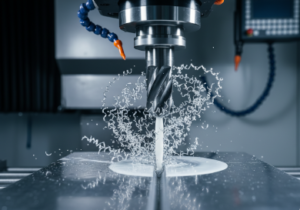
The blank is mounted on a high-precision, 5-axis milling machine. Machining occurs in stages:
- Roughing: Aggressive cuts remove the bulk of material, leaving a few millimeters of stock.
- Semi-Finishing: More precise cuts bring the part closer to its final dimensions.
- Finishing: The most critical stage. Using specialized tools, machinists achieve the final airfoil contour, surface finish (often requiring Ra values in the microns), and edge tolerances. High-speed machining techniques are frequently employed here.
- Feature Machining: Drilling bolt holes, machining the central bore, and adding any balancing or mounting features.
4. Post-Processing and Inspection
After machining, blisks undergo several vital post-processing steps:
- Deburring and Polishing: Removing any sharp edges or microscopic burrs that could act as stress risers.
- Surface Enhancement: Processes like shot peening are used to induce compressive surface stresses, dramatically improving fatigue life.
- Non-Destructive Testing (NDT): Every blisk is rigorously inspected using dye penetrant, fluorescent penetrant, or eddy current testing to detect surface flaws, and often X-ray or CT scanning for internal defects.
- Dimensional Verification: Coordinate Measuring Machines (CMM) and optical scanners are used to verify that every contour matches the digital model within microns.
The Compelling Advantages of CNC Machined Blisks
The significant investment in CNC machining blisks is justified by a host of operational benefits that translate directly into performance and economic gains.
Enhanced Performance and Efficiency: The seamless design reduces aerodynamic losses caused by gaps and joints in traditional assemblies. This leads to improved compression or expansion efficiency, directly translating to better fuel economy in aircraft engines and higher output in power turbines.
Weight Reduction: Eliminating blade roots, locking mechanisms, and the thicker disk required for slots results in a component that can be up to 30% lighter. In aerospace, weight savings are paramount, directly increasing payload capacity and reducing fuel burn.
Unmatched Reliability and Safety: The monolithic nature removes the risk of blade detachment—a catastrophic failure mode. The reduced part count also simplifies the rotor assembly, enhancing overall system reliability and safety.
Increased Design Freedom: Engineers are not constrained by blade attachment geometry. This allows for more aerodynamically optimized blade shapes, including integrally bladed rotors (IBRs) with swept or leaned blades for advanced performance.
Reduced Maintenance and Lifecycle Cost: While the initial manufacturing cost is high, blisks often have longer service lives and require less maintenance. There are no blade-root inspections or replacement cycles for individual blades, though repair of damaged blisk airfoils is a specialized field in itself.
Applications and Future Frontiers
CNC machined blisks are no longer exotic; they are the standard in many high-end applications.
Aerospace Propulsion
They are the heart of modern jet engines. From the front-end fan and compressor stages of commercial turbofans (like the GE90 and GEnx) to the high-pressure turbine stages of military fighter engines (like the F135 for the F-35), blisks enable the high thrust-to-weight ratios and efficiency demanded today.
Power Generation and Industrial Turbomachinery
In land-based gas turbines used for electricity generation and mechanical drive, blisks contribute to higher efficiency, which means more power from less fuel and lower emissions. They are also found in auxiliary power units (APUs), turbochargers, and cryogenic pumps.
Emerging Trends and Challenges
The future of blisk technology is tied to advanced manufacturing. Additive Manufacturing (3D Printing) is emerging as a complementary or alternative process, particularly for prototyping and creating blisks with internal cooling channels impossible to machine. Furthermore, the development of even more advanced materials, like ceramic matrix composites (CMCs), pushes the temperature boundaries. The challenge of repair and refurbishment of expensive blisks is driving innovations in laser cladding and adaptive machining.
Conclusion: The Symbol of Technological Integration
The CNC machined blisk stands as a powerful symbol of modern engineering's trajectory: towards integration, precision, and performance. It represents a perfect marriage of advanced materials science, aerodynamic design, and digital manufacturing prowess. By transforming a solid block of metal into a lightweight, strong, and aerodynamically perfect component, the process encapsulates the relentless human pursuit of efficiency and power. As the demands on turbines continue to grow—for cleaner, more efficient, and more powerful applications—the precision blisk will undoubtedly remain at the heart of innovation, spinning at the frontier of what is mechanically possible.