The Unseen Engine: Why Precision is Paramount in AI Chip Thermal Management
In the high-stakes race of artificial intelligence, the spotlight often falls on software algorithms, model architectures, and raw compute power. Yet, beneath the sleek exteriors of servers and data centers lies a critical, physical bottleneck: heat. AI chips (GPUs, TPUs, and specialized ASICs) push the boundaries of transistor density and clock speeds, generating thermal loads that can throttle performance and shorten lifespans. The humble heatsink, therefore, transforms from a simple piece of metal into a mission-critical component. Mastering the precision machining of AI chip heatsinks is not merely a manufacturing task; it is the discipline of unlocking sustained, reliable, and extreme computational performance.
Deconstructing the AI Heatsink: More Than Just a Fin Stack
An AI chip heatsink is a feat of thermal and mechanical engineering. Unlike standard CPU coolers, these components are designed to manage concentrated heat fluxes often exceeding 100W/cm² from large, powerful silicon dies. Their design is a complex interplay of material science, fluid dynamics, and precision manufacturing.
Core Components and Design Philosophy
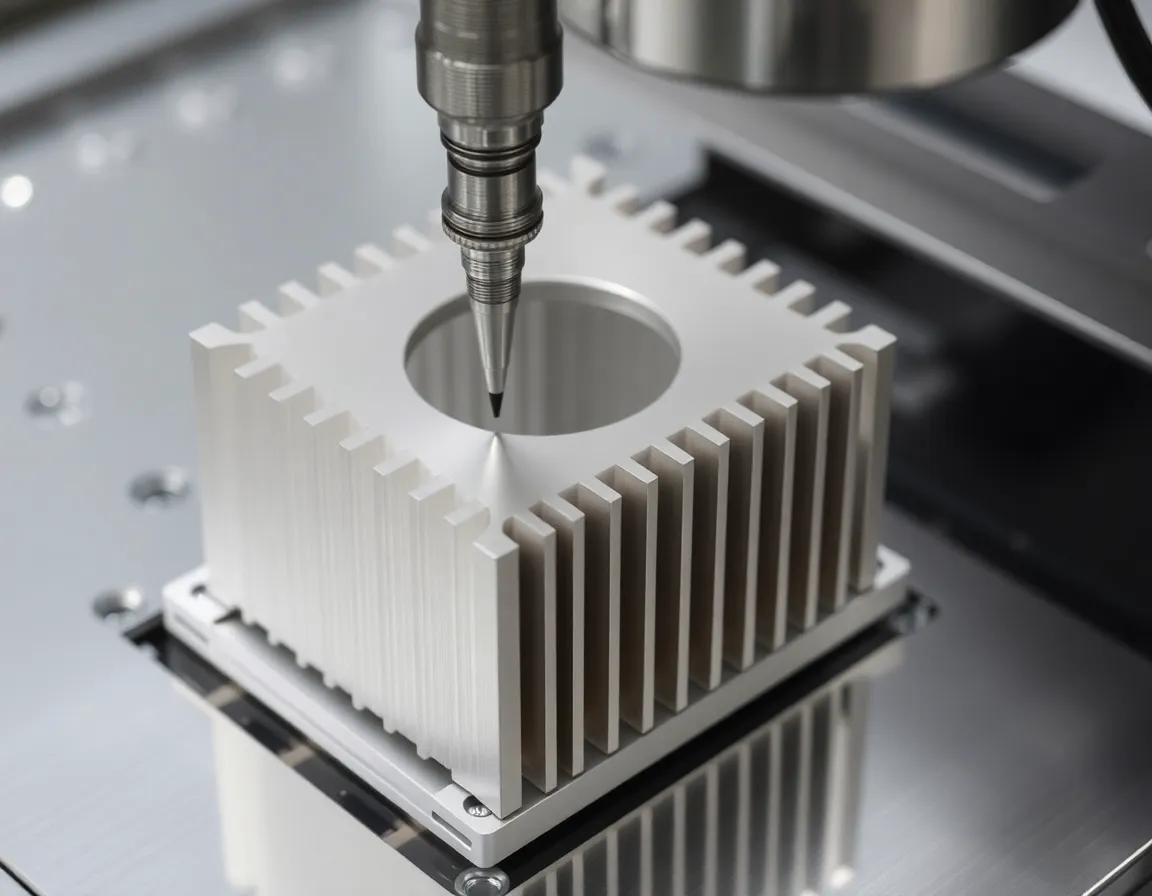
A typical high-performance AI heatsink consists of a baseplate that makes intimate contact with the chip, a dense array of fins to maximize surface area for heat dissipation, and often an integrated vapor chamber or heat pipes for lateral heat spreading. The design goal is to minimize the "thermal resistance" from the silicon junction to the ambient air. Every micron of imperfection in the baseplate flatness, every inconsistency in fin thickness, and every micro-gap at the interface adds resistance, directly translating to higher operating temperatures.
The Role of Precision Machining
Precision machining is the process of shaping raw material (typically aluminum or copper alloys) into the final, intricate heatsink geometry with tolerances measured in micrometers (µm). It encompasses advanced techniques like Computer Numerical Control (CNC) milling, skiving, forging, and often a combination thereof. For AI applications, machining must achieve not just dimensional accuracy, but also specific surface finishes and mechanical properties that are essential for optimal thermal transfer and structural integrity under stress.
The Precision Machining Workflow: From Billet to Thermal Masterpiece
Creating a heatsink capable of taming an AI chip is a multi-stage, tightly controlled process where each step is critical to the final performance.
1. Material Selection and Preparation
The journey begins with choosing the right material. High-purity copper (C110) offers superior thermal conductivity but is heavier and more expensive. Aluminum alloys (like 6061 or 6063) provide an excellent balance of conductivity, weight, and machinability. Advanced applications may use copper-aluminum composites or even diamond-embedded metals. The chosen billet is stress-relieved and prepared to ensure uniform material properties before any cutting begins.
2. High-Precision CNC Machining
This is the heart of the process. Multi-axis CNC machines, often with high-speed spindles and specialized tooling, carve the heatsink from the solid block.
- Baseplate Machining: Achieving a perfectly flat and smooth surface is non-negotiable. The baseplate is machined to a flatness often within 0.02mm over its entire area and given a specific surface finish (e.g., a Ra value below 0.8 µm) to ensure minimal gap when paired with a thermal interface material (TIM).
- Fin Creation: Fins can be created via skiving (peeling thin layers of metal from a block to form fins in one piece) or CNC milling. Skiving allows for extremely thin, tall, and tightly packed fins, maximizing surface area in a compact volume—a key requirement for dense server racks.
- Complex Feature Integration: Mounting holes, channels for heat pipes or vapor chambers, and custom contours for clearance are machined with extreme accuracy to ensure proper fitment and assembly pressure on the AI chip.
3. Secondary Processes and Finishing
After primary machining, several finishing steps are crucial:
- Deburring and Cleaning: Any microscopic burrs are removed to prevent damage to the chip or TIM and to ensure clean airflow.
- Surface Treatment: Anodizing (for aluminum) or nickel plating (for copper) may be applied to prevent corrosion and, in some cases, slightly improve emissivity.
- Planarization: The baseplate may undergo a final lapping or polishing step to guarantee the specified flatness and surface finish.
4. Rigorous Quality Assurance
Every heatsink is subjected to stringent inspection. Coordinate Measuring Machines (CMM) verify dimensional tolerances. Laser scanners and interferometers measure flatness and surface topography. Sample units undergo thermal performance testing in wind tunnels to validate heat dissipation metrics against computational fluid dynamics (CFD) models.
Benefits of Mastering Precision in AI Heatsink Machining
Investing in state-of-the-art precision machining yields tangible, system-level advantages for AI deployments.
- Sustained Peak Performance: Precision-machined heatsinks maintain lower junction temperatures, preventing thermal throttling. This allows AI chips to run at their boost clocks for longer, reducing training times and increasing inference throughput.
- Enhanced Reliability and Lifespan: Operating at lower, more consistent temperatures significantly reduces thermal cycling stress on the AI chip's solder bumps and internal connections, leading to higher mean time between failures (MTBF).
- Improved Power Efficiency: Cooler chips exhibit lower leakage currents. This translates to marginal but meaningful power savings at scale, a critical factor for large data centers with massive electricity costs.
- Enabling Higher Power Designs: As chipmakers design ever-more powerful processors (pushing into the 700W+ range), only the most precisely manufactured cooling solutions can keep pace, enabling the next generation of AI hardware.
- Optimized Form Factor: Precision machining allows for denser fin arrays and more efficient designs, enabling higher cooling capacity within the strict spatial constraints of 1U/2U servers and blade enclosures.
Applications and Future Trends
The demand for precision-machined heatsinks spans the entire AI ecosystem.
- Data Center GPUs: NVIDIA's HGX platforms, AMD's Instinct series, and cloud-specific AI accelerators all rely on custom, high-performance heatsinks.
- Edge AI and Autonomous Systems: In vehicles, robots, and drones, ruggedized, compact heatsinks must manage heat in challenging environments with limited airflow.
- AI Workstations and Supercomputers: From research labs to film studios, systems running multiple high-end GPUs require precisely machined cooling solutions, often in liquid-cooled configurations with cold plates.
The Road Ahead: Innovations in Machining and Design
The field is rapidly evolving. Additive manufacturing (3D printing) with metals is emerging, allowing for previously impossible geometries like conformal cooling channels and optimized lattice structures within the heatsink body. Direct-to-chip liquid cooling involves machining microfluidic channels directly into a cold plate that sits atop the AI chip, representing the pinnacle of precision thermal interface machining. Furthermore, the integration of embedded heat pipes and vapor chambers into a single machined unit is becoming more sophisticated, requiring seamless hybrid manufacturing techniques.
Best Practices for AI Chip Heatsink Procurement and Manufacturing
For system integrators and OEMs, navigating this specialized supply chain requires diligence.
- Partner with Specialists: Seek out machining partners with proven expertise in high-performance thermal solutions, not just general CNC shops. Look for certifications like ISO 9001 and AS9100.
- Design for Manufacturability (DFM): Collaborate early with your machining partner. Optimize designs to balance thermal performance with machinability, minimizing complex undercuts and unrealistic tolerances that drive up cost without benefit.
- Specify Critical Parameters Clearly: Clearly define and prioritize requirements: baseplate flatness, surface finish, fin density, material specs, and plating requirements. Understand which tolerances are critical for performance and which are for fitment.
- Invest in Prototyping and Testing: Never skip the thermal validation phase. Prototype heatsinks should be tested in a configuration as close to the final deployment as possible to gather real-world performance data.
- Consider the Total Thermal Solution: The heatsink is only one part of the chain. Factor in the thermal interface material, fan or pump performance, system airflow, and ambient conditions for a holistic approach.
Conclusion: The Foundation of AI's Physical Frontier
As artificial intelligence models grow exponentially in size and complexity, the physical hardware that supports them must evolve in lockstep. Mastering AI chip heatsink precision machining is a fundamental engineering discipline that sits at the intersection of materials, mechanics, and thermodynamics. It is a field where microns matter and perfection in execution directly fuels computational advancement. By ensuring that these powerful silicon brains operate in a stable, cool environment, precision-machined thermal solutions don't just prevent overheating—they enable the relentless pace of innovation that defines the AI era. The future of AI is not only written in code but is also carved, with impeccable accuracy, into metal.