
Small diameter does not automatically mean Swiss machining. The deciding issue is whether the part needs support close to the cutting zone while several turning, drilling, milling, or threading features are produced along a slender length. CNC Swiss machining process planning uses a sliding headstock and guide-bushing support strategy to control that geometry, but the benefits depend on diameter, length, material, feature sequence, quantity, and inspection. This guide explains when Swiss-type production earns its place and when a conventional turning center is the clearer route. The broader CNC machining process guide provides the parent workflow.
What Swiss Machining Changes at the Cutting Zone

Typical applications include small shafts, pins, sleeves, fittings, sensor components, medical hardware, connector parts, and miniature turned components with several features along their length. Swiss equipment may also integrate cross-drilling, milling, threading, and back-end work, reducing manual transfers for suitable production parts.
Swiss is still CNC turning. Its distinct value comes from how the bar is supported and how the machine handles feature access, not from a universal promise of tighter tolerance for every geometry.
Match the Process to Diameter, Length, and Features
The right process depends on the relationship between diameter, machined length, unsupported tendency, feature density, and quantity. A short, relatively large-diameter part may not gain enough from a guide bushing to justify Swiss-specific setup and tooling. A long, small-diameter component with multiple close-tolerance features may gain significantly from support near the cut.
| Part condition | Swiss value to evaluate | Question before quoting |
|---|---|---|
| Small diameter and long machined length | Support near the cutting zone | Will conventional chucking allow the required straightness and stability? |
| Many features along one bar-fed part | Integrated turning and live-tool operations | Can one sequence reduce transfers and handling? |
| Short and rigid component | Potential bar-feeding and repeat-production efficiency | Does volume justify the dedicated setup and tooling? |
| Complex back-end or cross features | Fewer secondary handling steps | How will the sub-spindle, cutoff, and back-end inspection be controlled? |
Use Guide-Bushing Support for Slender Geometry

Which features can still create difficulty?
- Very small holes or deep bores that require reliable chip evacuation.
- Thin sections that lose support after adjacent material is removed.
- Cross-drilled or milled features that interrupt a slender wall.
- Threads and grooves with demanding burr or runout requirements.
- Materials that generate heat, long chips, or rapid tool wear.
Support is not a replacement for design review. Sharp transitions, unnecessary tight tolerances, difficult tool access, and unsupported end features should still be discussed before programming.
Plan the Feature Sequence Along the Bar
A Swiss sequence must consider where the guide bushing supports the bar, which features are cut first, and when a section becomes too thin to resist cutting load. Roughing and support-preserving operations may precede final diameters. Cross-holes, milled flats, and threads are placed where the bar remains stable and where chips can exit without damaging a finished surface.
Sub-spindle pickup and cutoff create another controlled transition. The process plan should define when the back end is captured, which surface becomes the new reference, and how the reverse-end features are verified. A part that leaves the machine complete still needs a clear inspection coordinate system.
Simulation should include tools, holders, guide bushing, sub-spindle, cutoff position, and the actual stock model. It can reveal collision and access problems, but shop-floor checks remain necessary for bar straightness, loading, runout, coolant, and chip control.
Combine Turning With Live-Tool Features Carefully
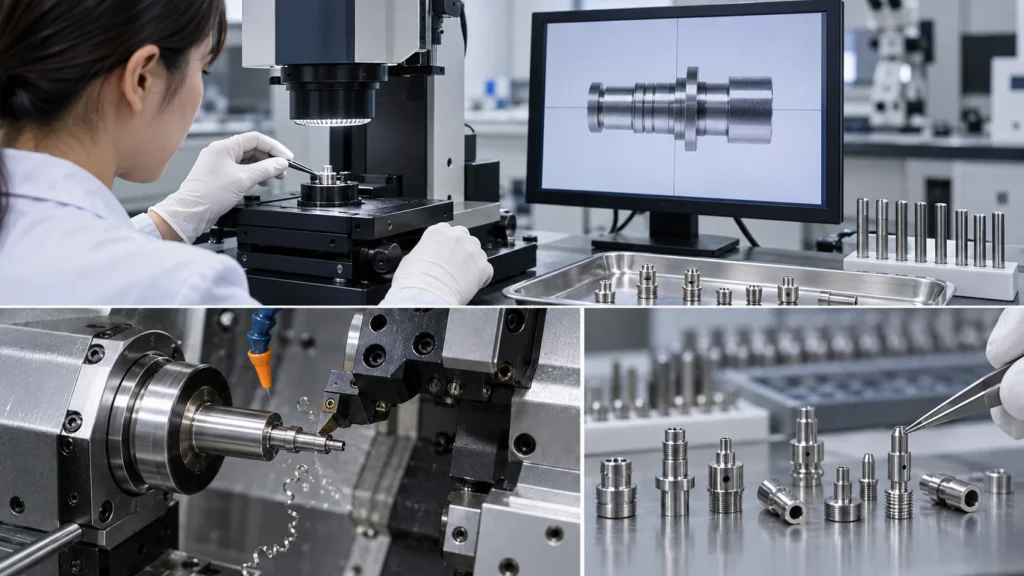
The supplier’s Swiss machining capability should be compared with the part’s diameter, length, feature density, material, and quantity. A service label alone does not prove that the guide-bushing arrangement, live tooling, or sub-spindle route fits the specific design.
Account for Material, Heat, and Chip Evacuation

Confirm exact grade, condition, certification, surface treatment, and cleaning requirements before the route is fixed. The material discussion should be connected to the CNC turning materials information, while final conditions remain specific to the equipment, tool, geometry, and batch.
Balance Setup Effort Against Production Quantity
Swiss machining can be attractive for repeat production because bar feeding and integrated operations may reduce manual handling. That does not make it the automatic choice for a single prototype. Dedicated guide-bushing setup, tooling, program prove-out, material loading, and inspection may be easier to justify when the part is stable and the quantity or repeat-order expectation supports the investment.
Compare total project cost rather than machine-hour price alone. Include setup, tool life, scrap risk, material yield, secondary operations, inspection, packaging, and the cost of changing a design after the process has been established.
Inspect Small Features With a Defined Method
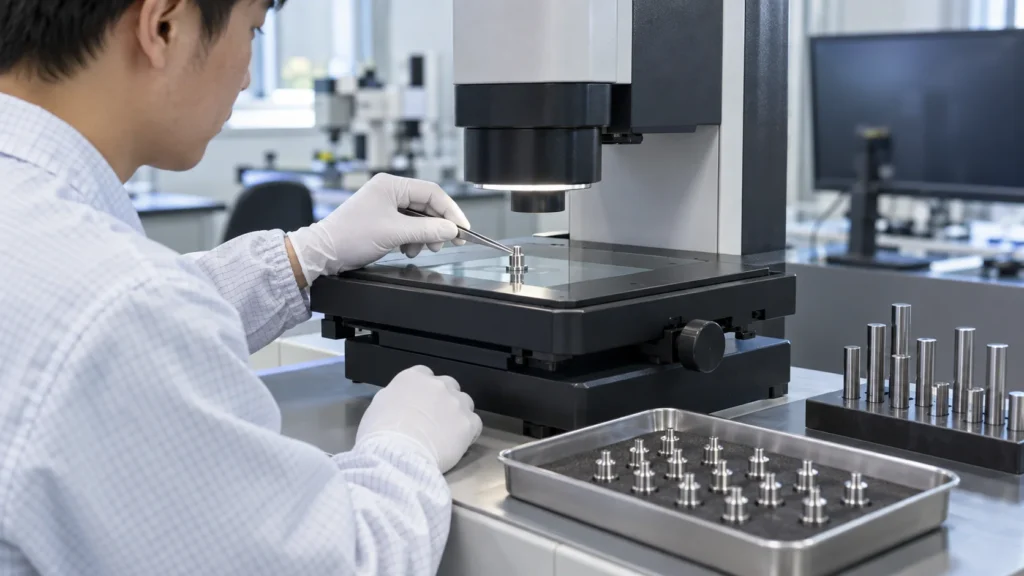
- Confirm material identity and batch traceability where required.
- Use suitable pin, thread, optical, air, or coordinate measurement methods for the feature.
- Define how small burrs, chips, scratches, and contamination are accepted or rejected.
- Check reverse-end features against the same reference logic used during machining.
- Specify first-article, sampling, report, and packaging requirements before production.
For supplier quality planning, review the quality management information and then define the project-specific measurements and records in the drawing or purchase order.
Prepare a Swiss Machining RFQ
Provide the 3D model, 2D drawing, revision, material and condition, quantity, forecast, surface finish, cleaning, packaging, and inspection requirements. Add the information that determines whether guide-bushing support is useful:
- Finished diameter range and total machined length.
- Thin sections, unsupported features, small holes, grooves, and thread details.
- Cross-drilling, milling, polygonal, or back-end features.
- Required runout, straightness, concentricity, burr, cleanliness, and cosmetic criteria.
- Prototype quantity, annual volume, repeat-order expectations, and first-article documents.
CNC Swiss Machining Process FAQs
What is CNC Swiss machining?
CNC Swiss machining is a bar-fed turning process that uses a sliding headstock and guide bushing to support material near the cutting zone while producing small, slender, or feature-dense components.
Is Swiss machining only for tiny parts?
Swiss machines are commonly selected for small-diameter or slender components, but diameter alone does not decide the route. Length, support needs, feature density, material, quantity, and inspection requirements must be considered together.
Why does a guide bushing help?
A guide bushing supports the bar close to the cutting area, which can reduce bending and vibration during material removal. Actual results still depend on alignment, bar condition, tooling, cutting conditions, and process sequence.
Can Swiss machining produce cross-holes and threads?
Many Swiss machines can combine turning with live-tool drilling, milling, and threading. The drawing must define feature position, standard, depth, burr condition, and inspection method.
When is conventional turning better than Swiss machining?
Conventional turning may be simpler for short, rigid parts, lower quantities, larger diameters, or geometry that does not benefit from guide-bushing support. Compare setup effort, quantity, feature access, tolerance risk, and total cost.
Swiss machining is a support strategy for a specific class of turned parts, not a universal upgrade. When diameter, length, features, material, quantity, and inspection align, guide-bushing support can give slender components a more stable path from bar stock to repeatable production.