
+86-188-7042-1176
project@juchengjm.com
Mon-Fri: 8am-6pm (GMT+8)
EN
ISO 9001:2015 Certified
Zinc
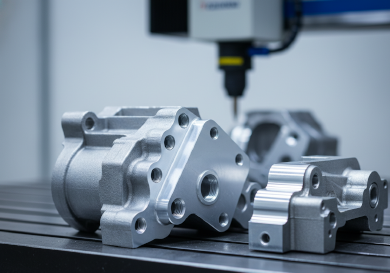
Zinc alloys (specifically the Zamak series) are staples in the automotive and consumer electronics industries due to their high strength, ductility, and ability to be cast into complex shapes. While Zinc is predominantly die-cast, CNC machining is critical for creating functional prototypes to validate designs before investing in expensive molds, or for performing precision secondary operations (drilling/tapping) on cast parts. Jucheng Precision, with its IATF 16949 certification, is an expert in machining Zinc automotive components. Our high-speed Haas/Mazak CNC machines effortlessly handle zinc alloys, delivering tight tolerances (+/- 0.01mm) and superior surface finishes. We also offer surface treatments like chromating and plating to enhance corrosion resistance.
Available Zinc Grades
| Grade | Common Name | Key Characteristics | Typical Applications |
|---|---|---|---|
| Zamak 3 | Zn-4Al | The industry standard. Excellent balance of physical and mechanical properties. High dimensional stability. | Automotive components, household hardware, electrical switchgear. |
| Zamak 5 | Zn-4Al-1Cu | Contains copper for higher tensile strength and hardness than Zamak 3. Slightly lower ductility. | Automotive parts requiring higher strength, accessories, fittings. |
| ZA-8 | Zinc-Aluminum Alloy | Higher aluminum content. Can be gravity cast. Superior creep resistance and strength. | Hydraulic components, decorative hardware. |
| ZA-12 | Bearing Alloy | Excellent bearing properties (good alternative to bronze). High hardness and strength. | Bearings, bushings, wear plates. |
Zinc Machining Capabilities
| Capability | Technical Description | Jucheng Advantage |
|---|---|---|
| Functional Prototyping | CNC machining solid Zinc blocks to simulate die-cast parts (Zamak 3/5) for fit and function testing. | Allows clients to validate designs and mechanical properties physically without paying for expensive die-casting molds. |
| Secondary Operations | Precision post-machining of die-cast zinc parts, including facing, boring, and tapping precise threads. | Our automated setups ensure high repeatability for large batches of automotive housings. |
| High-Speed Drilling/Tapping | Zinc is easy to machine; we utilize high-speed spindles to drill and tap holes rapidly. | Significantly reduces cycle times and costs for parts requiring multiple fastening points. |
| Surface Finishing | Providing Chromate Conversion, Zinc Plating, or Powder Coating services. | Enhances the natural corrosion resistance of Zinc and prepares it for harsh environments (Salt Spray Test compliant). |
Fabrication Guidelines for Zinc
Tooling:
Zinc is non-abrasive and soft. Standard high-speed steel (HSS) or uncoated carbide tools work excellently. Sharp cutting edges are required to prevent burrs on exit.
Workholding:
Zinc is dense but can be brittle compared to aluminum. Care must be taken not to over-clamp thin-walled sections to avoid cracking or deformation. Soft jaws are recommended.
Coolant:
Water-soluble coolant is recommended to keep the part cool and flush away chips. While Zinc can be machined dry, coolant prevents the material from smearing on the tool.
Safety Note:
Zinc dust can be flammable, though less so than Titanium/Magnesium. Good housekeeping and chip management are standard protocols at Jucheng.
Primary Application Industries
Automotive (IATF 16949)
Key Parts: Door lock housings, mirror brackets, seat belt components.
Why Zinc: High strength, dimensional stability, and ability to cast complex net-shape parts that require minimal machining.
Consumer Electronics
Key Parts: Laptop hinges, connector shields, chassis frames.
Why Zinc: Excellent EMI/RFI shielding properties and high-quality tactile feel (heavy/premium) for user interfaces.
Hardware & Construction
Key Parts: Window handles, locks, bathroom fixtures.
Why Zinc: Easily plated (Chrome/Nickel) for a decorative finish and durable enough for daily use.
Industrial Components
Key Parts: Gears, pulleys, motor housings.
Why Zinc: Self-lubricating properties (bearing bronze alternative) and vibration damping capabilities.
Material Properties
| Density | 6.6 - 6.7 g/cm³ |
| Tensile Strength | 220 - 400 MPa |
| Yield Strength | 200 - 300 MPa |
| Elongation at Break | 2 - 10 % |
| Elastic Modulus | 85 - 96 GPa |
| Hardness | 80 - 100 HB |
| Thermal Conductivity | 105 - 115 W/m-K |
| Electrical Conductivity | 25 - 27 % IACS |
| Melting Point | 380 - 420 °C |
| Max. Part Size | 2000 mm (L) x 800 mm (W) x 600 mm (H) |