
+86-188-7042-1176
project@juchengjm.com
Mon-Fri: 8am-6pm (GMT+8)
EN
ISO 9001:2015 Certified
Ultem (PEI)
Ultem (Polyetherimide / PEI) is a high-performance amorphous thermoplastic known for its amber transparency, exceptional flame resistance, and high dielectric strength. It is a preferred material for Aerospace and Medical applications where heat and chemical resistance are critical. At Jucheng Precision, we have mastered the art of machining Ultem, which can be prone to stress cracking if handled incorrectly. We utilize specialized annealing processes and compatible coolants to ensure zero-defect parts. With our ISO 13485 certification and fleet of 5-axis CNC machines, we produce complex Ultem manifolds and insulators with tight tolerances (+/- 0.02mm) and superior optical clarity (via vapor polishing) for clients worldwide.
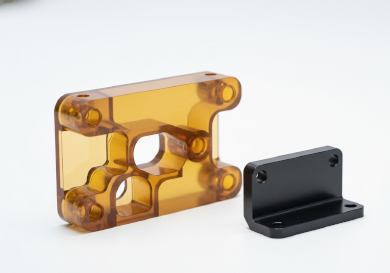
Available Ultem (PEI) Grades
| Grade | Common Name | Key Characteristics | Typical Applications |
|---|---|---|---|
| Ultem 1000 | Standard / Unfilled | Translucent amber color. Excellent balance of strength, heat resistance, and dielectric properties. FDA compliant. | Medical devices, electrical insulators, microwave parts, food processing. |
| Ultem 2300 | 30% Glass Filled | Reinforced with glass fiber. Higher tensile strength and stiffness than 1000, but opaque (tan/brown). | Structural aerospace components, reusable medical instruments, high-load clips. |
| Ultem 2100 | 10% Glass Filled | Intermediate strength between 1000 and 2300. Better finish than 2300 due to lower glass content. | Housings, structural brackets requiring moderate reinforcement. |
| Ultem 9085 | Aerospace Grade | Optimized flow and flame/smoke/toxicity (FST) ratings. Often used in additive mfg, but also machined. | Aircraft interior components, ducting, clips. |
Ultem Machining Capabilities
| Capability | Technical Description | Jucheng Advantage |
|---|---|---|
| Optical Polishing | Post-machining Vapor Polishing or mechanical buffing to restore transparency to machined Ultem 1000 parts. | We can achieve near-optical clarity for sight glasses and fluid monitoring components. |
| Deep Hole Drilling | Drilling high aspect ratio holes without cracking the brittle material. | We use specialized peck drilling cycles and coolant control to evacuate chips and prevent heat stress. |
| Stress Relieving | In-house annealing ovens to treat parts before final finishing. | Essential for Ultem to prevent “crazing” or cracking when exposed to chemicals later in service. |
| Precision Milling | 5-axis milling of complex manifolds and electrical housings. | Capable of maintaining dimensional stability even on thin-walled Ultem insulators. |
Fabrication Guidelines for Ultem
Coolant Selection:
Ultem is sensitive to stress cracking. Standard petroleum-based coolants can cause immediate failure. We use non-aromatic, water-soluble coolants or air blast specifically tested for amorphous plastics.
Tooling:
Carbide tools are required, especially for glass-filled grades (Ultem 2300) which are highly abrasive. We use tools with positive rake angles to cut freely and reduce heat generation.
Clamping Strategy:
To avoid cracking, clamping forces must be distributed evenly. Soft jaws and vacuum tables are preferred. We avoid point-loads or overtightening vices.
Annealing:
Due to internal stresses from the extrusion process, Ultem stock should often be annealed before machining critical dimensions to ensure the part doesn’t warp after material removal.
Primary Application Industries
Aerospace
Key Parts: Electrical connectors, lighting housings, air vent components.
Why Ultem: Meets strict Flame, Smoke, and Toxicity (FST) standards required for aircraft interiors.
Medical Devices (ISO 13485)
Key Parts: Surgical instrument handles, sterilization trays, endoscopic components.
Why Ultem: Can withstand repeated autoclaving (steam sterilization) cycles without degrading.
Electronics
Key Parts: High-voltage switches, connectors, coil bobbins, burn-in sockets.
Why Ultem: High dielectric strength and stable electrical properties over a wide temperature range.
Food Industry
Key Parts: Probes, manifolds, sight glasses.
Why Ultem: FDA compliance (Unfilled grades) and resistance to hot water and steam cleaning.
Material Properties
| Density | 1.27 - 1.51 g/cm³ |
| Tensile Strength | 105 - 165 MPa |
| Impact Strength | 50 - 60 J/m |
| Heat Deflection Temp | 200 - 215 °C |
| Hardness | 109 Rockwell R |
| Continuous Service Temp | 170 °C |
| Water Absorption | 0.25 % |
| Dielectric Strength | 33 kV/mm |
| Melting Point | 219 °C (Tg) °C |
| Max. Part Size | 2000 mm (L) x 800 mm (W) x 600 mm (H) |