
+86-188-7042-1176
project@jcproto.com
Mon-Fri: 8am-6pm (GMT+8)
EN
ISO 9001:2015 Certified
Tool Steel O1
AISI O1 is a manganese-chromium-tungsten oil-hardening tool steel characterized by its versatility and ease of use. It is widely considered the "general purpose" steel of the cold-work family, offering a perfect balance between hardness, toughness, and machinability. Its primary advantage lies in its consistent and predictable response to oil quenching, which results in minimal dimensional changes compared to water-hardening steels. At Jucheng Precision, we recommend O1 for intricate parts that require high precision and a durable cutting edge. Whether we are producing complex precision gauges or industrial cutting tools, our expertise in machining and managing the O1 heat treatment process ensures a reliable, high-performance final product.
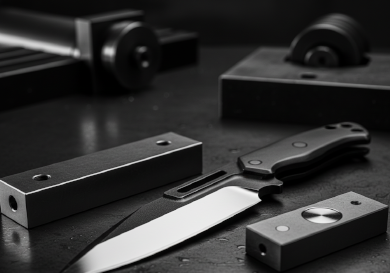
Tool Steel O1 Machining Capabilities
| Capability | Technical Description | Jucheng Advantage |
|---|---|---|
| Easy Machinability Roughing | O1 is among the easiest tool steels to machine in its annealed state. We utilize standard CNC milling to remove bulk material rapidly. | Jucheng offers competitive lead times for O1 components due to high material removal rates and lower tool wear compared to A2 or D2. |
| High-Precision Grinding | Achieving ultra-tight tolerances on O1 surfaces post-oil quenching to ensure perfect flatness and sizing. | We hold tolerances as tight as +/- 0.002mm, making our O1 parts ideal for precision master gauges and inspection tools. |
| Complex Profile Turning | Turning intricate O1 shafts and mandrels with smooth surface finishes prior to heat treatment. | Ensures that after quenching, minimal finish grinding is required, saving time and cost for our clients. |
| Hard Finishing | Using specialized inserts to finish-machine O1 after it reaches 57-62 HRC. | Eliminates the “black scale” from oil quenching and ensures the final part meets high cosmetic and functional standards. |
Fabrication Guidelines for Tool Steel O1
Oil Quenching Stability:
O1 is designed to be quenched in oil, which is gentler than water quenching. Tip: This results in excellent dimensional stability with minimal risk of cracking during the hardening process.
Decarburization Risk:
During heat treatment, O1 is prone to losing carbon on the surface (decarb). Tip: We always leave a 0.3mm – 0.5mm grinding allowance to remove this soft surface layer after the hardening cycle.
Through-Hardening:
O1 has good hardenability and can be through-hardened even in relatively thick sections. Tip: It achieves a very consistent hardness of 57-62 HRC, suitable for long-lasting cutting edges.
Rust Prevention:
Like most cold-work tool steels, O1 contains little chromium and will rust if not oiled. Tip: We apply protective industrial oil or rust inhibitors to all finished O1 parts before shipping.
Primary Applications
Precision Gauges
Master blocks, plug gauges, and ring gauges where dimensional accuracy and wear resistance are mandatory.
Custom Knife Blades
A favorite for custom cutlery and industrial blades due to its ease of sharpening and excellent edge retention.
Stamping Dies
Small-to-medium production run dies for blanking, forming, and trimming soft metals.
Machine Components
Collets, bushings, and wear plates that require high surface hardness and structural toughness.
Properties
| Density | 7.85 g/cm³ |
| Tensile Strength | 1800 - 2200 MPa |
| Yield Strength | 1400 - 1600 MPa |
| Hardness | 57 - 62 HRC |
| Impact Strength | 25 J (Charpy V-notch) |
| Thermal Conductivity | 26.0 W/m-K |
| Machinability Rating | 90% (Annealed) |
| Weldability | Fair |
| Wear Resistance | Moderate to High |
| Max Part Size | 2000 x 800 x 600 mm |