
+86-188-7042-1176
project@jcproto.com
Mon-Fri: 8am-6pm (GMT+8)
EN
ISO 9001:2015 Certified
Tool Steel H13
AISI H13 is the most widely used hot-work tool steel in the world. It is a chromium-molybdenum-vanadium alloy characterized by its excellent toughness and resistance to thermal fatigue cracking (heat checking). Unlike cold-work steels, H13 maintains high hardness and structural integrity even under prolonged exposure to elevated temperatures, making it the gold standard for die-casting dies and hot extrusion tools. At Jucheng Precision, we specialize in the high-precision CNC machining of H13 for the mold and die industry. We provide a comprehensive manufacturing solution, including complex 5-axis cavity milling, precision gun drilling for cooling channels, and managed heat treatment to achieve the ideal balance of hardness and toughness (48-54 HRC) for your production tooling.
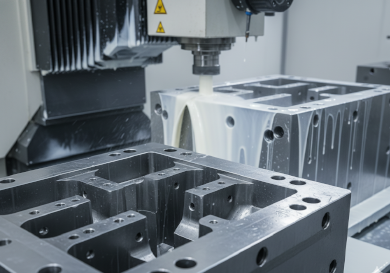
Tool Steel H13 Machining Capabilities
| Capability | Technical Description | Jucheng Advantage |
|---|---|---|
| Deep Cavity 5-Axis Milling | H13 is the standard for die-casting. We use simultaneous 5-axis milling to reach deep into complex mold cavities with shorter, more rigid tools. | Our high-speed Haas/Mazak centers minimize tool deflection, ensuring perfect draft angles and wall thickness for complex aluminum and zinc casting dies. |
| Gun Drilling for Cooling Channels | Machining deep, precise internal water lines for thermal management within the mold block. | We ensure precise alignment of cooling channels to maximize heat dissipation, preventing “hot spots” in your production molds. |
| Hard Milling (Post-Quench) | Finish-machining H13 after it has been hardened to 48-54 HRC using advanced ceramic and CBN tooling. | Allows us to correct heat-treat distortion, ensuring that sliding mold cores and parting lines fit with zero clearance. |
| Surface Nitriding Prep | Machining H13 surfaces to Ra 0.8μm to prepare for gas nitriding to achieve extreme surface wear resistance. | Extends the life of your dies when molding abrasive glass-filled plastics or during high-pressure metal casting. |
Fabrication Guidelines for Tool Steel H13
Hot-Hardness Property:
H13 is designed to maintain its hardness and strength even when exposed to high temperatures (up to 540°C). Tip: This “red hardness” makes it the premier choice for tools that contact molten metal.
Thermal Fatigue Resistance:
H13 is highly resistant to “heat checking” (micro-cracks caused by repeated heating and cooling). Tip: We recommend a vacuum hardening process with a controlled nitrogen quench to maximize this property.
Avoid Sharp Corners:
Thermal stress concentrates at sharp edges. Tip: Always design internal radii (fillets) into mold cavities to prevent premature cracking during the die-casting cycle.
Machinability:
In the annealed state, H13 is moderately easy to machine (approx. 70% of 1212). However, it is abrasive to tools. Tip: We use TiAlN coated tools to handle the heat generated during roughing passes.
Primary Applications
Die Casting Dies
The industry standard for aluminum, magnesium, and zinc high-pressure die casting mold cores and cavities.
Hot Extrusion Dies
Dies and mandrels used to push hot metal through profiles, requiring high strength at elevated temperatures.
Plastic Injection Molds
Used for high-production molds and those processing abrasive engineering plastics where 420 stainless is not required.
Forging Dies
Hammer and press dies for hot-forging steel and non-ferrous components.
Properties
| Density | 7.80 g/cm³ |
| Tensile Strength | 1200 - 1900 MPa |
| Yield Strength | 1000 - 1650 MPa |
| Hardness | 48 - 54 HRC |
| Impact Strength | 30 J (Charpy V-notch) |
| Thermal Conductivity | 24.3 W/m-K |
| Continuous Service Temp | Up to 540 °C |
| Machinability Rating | 70% (Annealed) |
| Weldability | Fair |
| Max Part Size | 2000 x 800 x 600 mm |