
+86-188-7042-1176
project@jcproto.com
Mon-Fri: 8am-6pm (GMT+8)
EN
ISO 9001:2015 Certified
8620 Steel
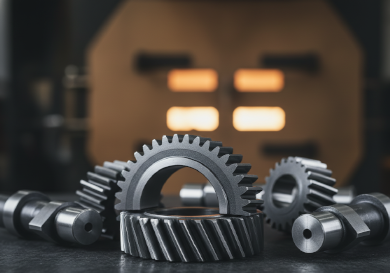
AISI 8620 is a low-nickel, chromium-molybdenum alloy steel specifically formulated for case hardening (carburizing). It offers an exceptional combination of wear resistance on the surface and high impact toughness in the core. Unlike through-hardening steels, 8620 allows engineers to design parts that are "hard on the outside, tough on the inside," making them nearly immune to snapping under heavy shock loads. At Jucheng Precision, we specialize in the precision CNC machining of 8620 components for the Automotive and Heavy Industrial sectors. We provide a complete manufacturing cycle, including high-speed gear cutting, managed carburizing, and final precision grinding to meet your exact assembly requirements.
8620 Steel Machining Capabilities
| Capability | Technical Description | Jucheng Advantage |
|---|---|---|
| Pre-Carburizing Turning | Machining 8620 blanks to near-net shape with precise allowances for the carburizing and quenching process. | We provide high-speed CNC turning for gear blanks, ensuring perfect concentricity before the hardening process. |
| Complex Gear Cutting | Milling and hobbing intricate gear teeth and splines in the annealed state for maximum tool life. | Our 4-axis and 5-axis machines can generate complex tooth profiles that meet strict AGMA quality standards. |
| Case Hardening Management | Overseeing the carburizing process to achieve a specific case depth (e.g., 0.5mm – 1.5mm) and surface hardness. | We offer managed heat treatment, delivering 8620 parts with a surface hardness of 58-62 HRC while keeping the core tough. |
| Hard Finish Grinding | Post-hardening grinding of bores, journals, and teeth to correct any minor heat-treat distortion. | Jucheng’s precision grinding ensures your final gears and pins meet +/- 0.005mm tolerances for silent and durable operation. |
Fabrication Guidelines for 8620 Alloy Steel
Carburizing Strategy:
8620 is designed to be carburized. This adds carbon to the surface, allowing it to reach high hardness (60+ HRC) while the low carbon core remains ductile. Tip: Ideal for parts subject to high shock and heavy surface wear.
Machinability:
In its annealed state, 8620 has excellent machinability (approx. 65% of 1212). It shears cleanly and responds well to standard carbide tooling. Tip: Maintain sharp tools to prevent surface tearing.
Distortion Control:
Quenching can cause dimensional changes. Tip: We recommend leaving 0.2mm to 0.4mm of grinding stock on critical diameters to be finished after the hardening cycle.
Weldability:
8620 can be welded easily in the annealed state using standard methods. However, welding after case-hardening is not recommended as it will destroy the surface properties.
Primary Applications
Transmission & Gearing
Drive gears, pinions, splined shafts, and ring gears for automotive and heavy machinery industries.
Engine Components
Camshafts, piston pins, and tappets that require extreme surface wear resistance and high core toughness.
Industrial Machinery
Fasteners, pins, bushings, and universal joints that must withstand high impact and abrasion.
Oil & Gas Tools
Chain pins and drill bit components exposed to high-pressure friction and shock loads.
Properties
| Density | 7.85 g/cm³ |
| Tensile Strength | 530 - 660 MPa |
| Yield Strength | 380 - 450 MPa |
| Surface Hardness | 58 - 62 HRC |
| Core Hardness | 20 - 35 HRC |
| Elongation at Break | 15 - 25% |
| Thermal Conductivity | 46.6 W/m-K |
| Machinability Rating | 65% |
| Weldability | Good |
| Case Depth | 0.5 - 1.5 mm |
| Max Part Size | 2000 x 800 x 600 mm |