
+86-188-7042-1176
project@juchengjm.com
Mon-Fri: 8am-6pm (GMT+8)
EN
ISO 9001:2015 Certified
PEEK
PEEK (Polyetheretherketone) is one of the highest-performing thermoplastics in the world, renowned for its exceptional chemical resistance, high-temperature stability, and strength comparable to some metals. At Jucheng Precision, we specialize in machining complex PEEK components for the most demanding industries. Our facility utilizes ISO 13485 certified processes to manufacture medical-grade PEEK implants (like spinal cages) and surgical instruments. Machining PEEK requires strict process control to prevent stress and deformation. We employ proprietary annealing cycles and use high-speed Haas/Mazak CNC machines with sharp tooling to hold tolerances as tight as +/- 0.02mm, ensuring your parts perform reliably in the human body or aircraft engines.
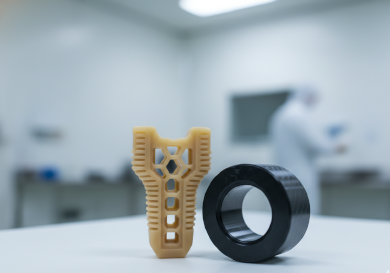
Available PEEK Grades
| Grade | Common Name | Key Characteristics | Typical Applications |
|---|---|---|---|
| Unfilled PEEK | Virgin PEEK / Natural | High purity, beige color. excellent toughness and chemical resistance. FDA compliant grades available. | Medical implants, food processing parts, general engineering. |
| Glass-Filled PEEK | 30% GF PEEK | Added glass fibers increase stiffness and reduce thermal expansion. Harder on tools. | Structural parts, insulators, support rings requiring high rigidity. |
| Carbon-Filled PEEK | 30% CF PEEK | Highest strength and stiffness. Enhanced thermal conductivity and wear resistance. Black color. | Aerospace components, high-load wear parts, pump vanes. |
| Bearing Grade PEEK | PEEK HPV | Modified with carbon fiber, PTFE, and graphite for low friction and self-lubrication. | Bearings, bushings, wear pads, dynamic seals. |
PEEK Machining Capabilities
| Capability | Technical Description | Jucheng Advantage |
|---|---|---|
| Stress-Free Machining | Implementation of in-process annealing cycles to relieve internal stresses caused by machining material removal. | Prevents parts from warping or twisting over time, ensuring long-term dimensional stability. |
| Micro-Machining | Precision milling of tiny features (e.g., 0.3mm holes, fine threads) for medical implants using high-speed spindles. | Our ISO 13485 protocols ensure contamination-free processing for medical-grade PEEK. |
| 5-Axis Complex Milling | Machining organic shapes and manifolds with undercuts in a single setup. | Ideal for complex aerospace brackets and medical device housings, reducing setup errors. |
| Surface Finishing | achieving Ra 0.4μm finishes through fine machining and vapor polishing or mechanical buffing. | Crucial for sealing surfaces in oil & gas applications and smooth contact surfaces in implants. |
Fabrication Guidelines for PEEK
Heat Control:
PEEK has low thermal conductivity. Heat generated during cutting stays in the part, which can cause size variation or melting. We use air blast or clean coolant to manage temperature.
Tooling:
We use positive-rake, sharp carbide tools. PEEK is abrasive (especially glass/carbon-filled grades), so diamond-coated (DLC) tools are often used to extend tool life and maintain finish.
Clamping:
Though hard, PEEK is a plastic. Excessive clamping force will deform it. We use vacuum fixtures or soft jaws with regulated pressure to hold parts securely without distortion.
Annealing:
For critical tolerances, we rough machine the part, anneal it in an oven to release stress, and then finish machine it to final size. This is a standard procedure at Jucheng.
Primary Application Industries
Medical Implants (ISO 13485)
Key Parts: Spinal cages, bone screws, dental healing caps.
Why PEEK: Biocompatible, radiolucent (invisible to X-rays), and has an elastic modulus similar to human bone.
Aerospace
Key Parts: Cable clamps, bushings, thermal insulators.
Why PEEK: Replaces metal to save weight while withstanding high temperatures and aggressive aviation fluids.
Oil & Gas
Key Parts: Backup rings, valve seats, electrical connectors.
Why PEEK: Withstands high pressure, high temperature (HPHT), and corrosive downhole environments.
Semiconductor
Key Parts: Wafer handling tools, vacuum wands.
Why PEEK: High purity, low outgassing, and resistance to harsh chemical etching processes.
Material Properties
| Density | 1.30 - 1.50 g/cm³ |
| Tensile Strength | 90 - 130 MPa |
| Impact Strength | 60 - 85 J/m |
| Heat Deflection Temp | 152 - 315 °C |
| Hardness | 85 Shore D |
| Continuous Service Temp | 250 - 260 °C |
| Dielectric Strength | 19 - 22 kV/mm |
| Water Absorption | 0.1 - 0.5 % |
| Melting Point | 343 °C |
| Max. Part Size | 2000 mm (L) x 800 mm (W) x 600 mm (H) |