
+86-188-7042-1176
project@jcproto.com
Mon-Fri: 8am-6pm (GMT+8)
EN
ISO 9001:2015 Certified
PBT (Polybutylene Terephthalate)
PBT (Polybutylene Terephthalate) is a semi-crystalline engineering thermoplastic known for its exceptional dimensional stability, high heat resistance, and superior electrical insulation properties. It is highly resistant to solvents and environmental stress, making it an ideal choice for the Automotive and Electronic industries. At Jucheng Precision, we specialize in the high-tolerance CNC machining of PBT. Utilizing our high-speed 5-axis CNC machines, we can produce complex thin-walled housings and connectors with precision (+/- 0.02mm). Our facility ensures that PBT parts maintain their mechanical integrity and tight fits, supporting your mission-critical applications in sensor housings and switchgear.
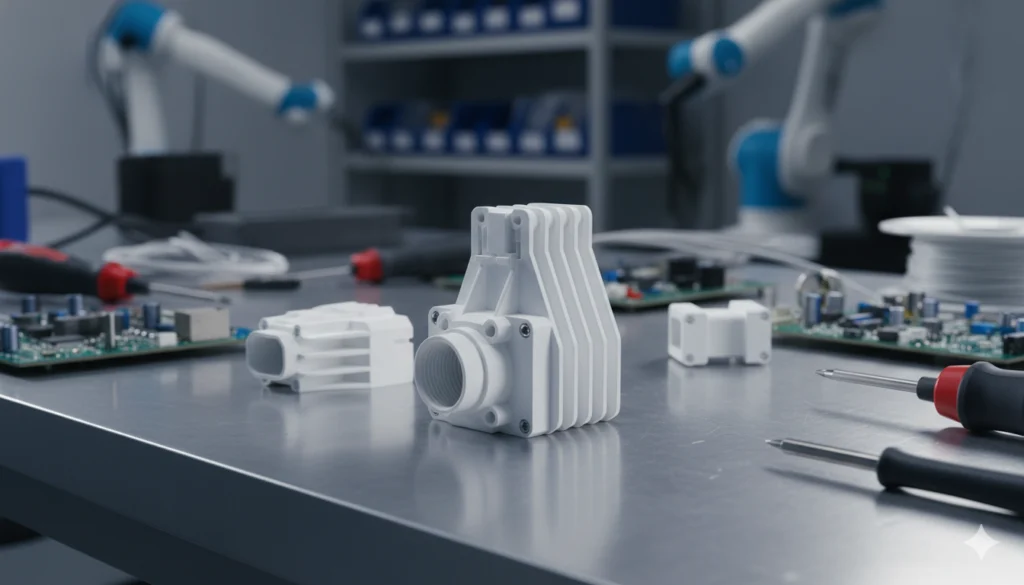
Available PBT Material Types
| Grade | Common Name | Key Characteristics | Typical Applications |
|---|---|---|---|
| Standard PBT | Unfilled PBT | Excellent sliding properties and high toughness. Good electrical insulation. | Valve parts, pump housings, electrical insulators. |
| Glass-Filled PBT | PBT GF30 | Reinforced with 30% glass fiber for extreme rigidity and heat deflection resistance. | Automotive sensor housings, motor components, connectors. |
| Flame Retardant PBT | PBT-FR | Meets UL94 V-0 standards. Essential for regulated electronics. | Switchgear, sockets, power supply components. |
PBT Machining Capabilities
| Capability | Technical Description | Jucheng Advantage |
|---|---|---|
| Thin-Wall Milling | Machining intricate internal ribs and wall sections down to 0.5mm without material failure. | Our 5-axis setups ensure that complex electronic housings are produced in a single setup for maximum alignment. |
| High-Speed Precision Drilling | Drilling micro-hole patterns for electrical pins with zero burr formation. | Achieves perfect positional accuracy (+/- 0.01mm) for multi-pin connector assemblies. |
| Abrasive-Resistant Strategies | Using specialized diamond-coated tools for machining Glass-Filled PBT (GF30). | Prevents tool wear-induced dimensional drift, ensuring tight tolerances across large batches. |
Fabrication Guidelines for PBT
Thermal Sensitivity: PBT is sensitive to heat during cutting. We use sharp, high-rake tools and optimized feed rates to prevent the material from softening or melting on the cutting edge.
Low Moisture Absorption: PBT absorbs very little water, meaning it holds its dimensions much better than Nylon. This allows for tighter initial clearances in mechanical assemblies.
Brittle Behavior in GF Grades: Glass-filled PBT is brittle. We use optimized entry and exit strategies to prevent “chipping” at the edges of the part.
Primary Application Industries
Automotive Engineering: Ignition system components, sensor housings, and exterior mirror parts requiring heat and solvent resistance.
Electronics: Connectors, coil bobbins, and switch components requiring high dielectric strength and dimensional stability.
Industrial Machinery: Pump impellers and valve bodies exposed to chemicals or high operating temperatures.
Material Properties
| Density | 1.30 - 1.55 g/cm³ |
| Tensile Strength | 50 - 160 MPa |
| Elastic Modulus | 2.5 - 10.0 GPa |
| Hardness | 115 - 125 HRB |
| Heat Deflection Temp | 150 - 210 °C |
| Water Absorption | 0.05 - 0.10 % |
| Dielectric Strength | 16 - 20 kV/mm |
| Max Part Size | 2000 x 800 x 600 mm |