
+86-188-7042-1176
project@juchengjm.com
Mon-Fri: 8am-6pm (GMT+8)
EN
ISO 9001:2015 Certified
Copper
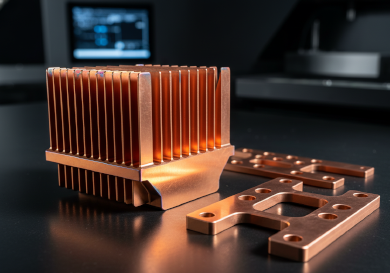
Copper is the industry standard for thermal and electrical conductivity, making it essential for electronics and automotive (EV) applications. However, pure copper (like C10100/C11000) is soft and "gummy," making it difficult to machine without deformation. Jucheng Precision has mastered copper machining strategies using specialized sharp carbide tooling and optimized coolant systems. We utilize our 25 sets of 5-axis CNC machines to produce intricate heat sinks with high aspect ratios that standard 3-axis machines cannot achieve. As an IATF 16949 certified manufacturer, we also supply high-volume, high-precision copper busbars and connectors for the electric vehicle industry, ensuring 100% electrical performance and surface integrity.
Available Copper Grades
| Grade | Common Name | Key Characteristics | Typical Applications |
|---|---|---|---|
| C10100 | Oxygen-Free Electronic (OFE) | 99.99% pure copper. Highest conductivity rating (101% IACS). No embrittlement. | High-end audio, vacuum interrupters, particle accelerators, superconductor components. |
| C11000 | Electrolytic Tough Pitch (ETP) | 99.9% pure. Standard grade for electrical use. Excellent conductivity (100% IACS). | Busbars, wiring, electrical contacts, heat sinks, gaskets. |
| C14500 | Tellurium Copper | Free-machining copper. Contains ~0.5% Tellurium. Machinability rating of 85% (vs 20% for pure copper). | High-volume machined parts, welding torch tips, electrical connectors. |
| C17200 | Beryllium Copper | High strength (comparable to steel) and hardness, non-sparking, non-magnetic. Hazardous dust. | Springs, load cells, oil & gas drilling tools, aerospace bushings. |
Copper Machining Capabilities
| Capability | Technical Description | Jucheng Advantage |
|---|---|---|
| High-Efficiency Milling | Using 5-axis CNC centers to mill complex cooling channels and thin fins on copper heat sinks. | We achieve thin-wall features (down to 0.5mm) without bending the soft copper fins. |
| EDM Electrode Mfg | Machining high-precision copper electrodes for Die Sinking EDM applications. | Our precision ensures that the electrode shape is perfect, translating to high-quality molds for clients. |
| Surface Protection | Post-machining Electroless Nickel Plating, Silver Plating, or Passivation. | Prevents copper oxidation (green patina) and ensures long-term solderability and conductivity. |
| Precision Turning | Turning of electrical contacts, pins, and terminals with smooth surface finishes (Ra 0.4). | Ensures maximum contact area for electrical transmission, critical for high-voltage applications. |
Fabrication Guidelines for Copper
Tooling Selection:
Copper is “sticky.” We use highly polished carbide tools with sharp, positive rake angles. This helps shear the metal cleanly rather than pushing it, preventing Built-Up Edge (BUE) which ruins surface finish.
Workholding:
Because copper is ductile and heavy, it can deform under clamping pressure. We use custom soft jaws or vacuum fixtures to hold parts securely without leaving clamp marks or distorting the geometry.
Feeds & Speeds:
We optimize speeds to avoid excessive heat which can make copper “gummy.” Aggressive feed rates are often used to break chips, which otherwise tend to be long and stringy.
Drilling Deep Holes:
Drilling copper requires “peck drilling” cycles to clear long chips. We use high-pressure coolant to flush chips out, preventing them from jamming and breaking the drill.
Primary Application Industries
Automotive & EV (IATF 16949)
Key Parts: High-voltage busbars, battery terminals, charging contacts.
Why Copper: Maximizes efficiency in power transmission and battery charging systems.
Electronics & Semiconductors
Key Parts: CPU heat sinks, cold plates, liquid cooling blocks.
Why Copper: Superior thermal conductivity pulls heat away from sensitive chips faster than aluminum.
Industrial Manufacturing
Key Parts: Welding electrodes, EDM electrodes, power distribution blocks.
Why Copper: High melting point and conductivity make it ideal for transferring energy (welding/sparking).
Aerospace
Key Parts: Heat exchangers, avionics cooling systems.
Why Copper: Reliability in thermal management for mission-critical flight electronics.
Material Properties
| Density | 8.90 - 8.96 g/cm³ |
| Tensile Strength | 200 - 350 MPa |
| Yield Strength | 60 - 300 MPa |
| Elongation at Break | 30 - 50 % |
| Elastic Modulus | 110 - 120 GPa |
| Hardness | 40 - 90 HRB |
| Thermal Conductivity | 350 - 390 |
| Electrical Conductivity | 85 - 101 % IACS |
| Melting Point | 1083 °C |
| Max. Part Size | 2000 mm (L) x 800 mm (W) x 600 mm (H) |