
+86-188-7042-1176
project@juchengjm.com
Mon-Fri: 8am-6pm (GMT+8)
EN
ISO 9001:2015 Certified
Brass
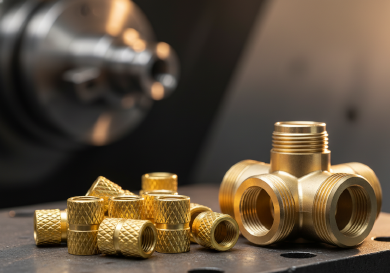
Brass is renowned for its excellent machinability ("free-machining"), corrosion resistance, and attractive golden appearance. At Jucheng Precision, we leverage the speed of brass processing to offer cost-effective, high-volume production solutions. Our facility is equipped with specialized Swiss-style turning centers and Turn-Mill machines, perfect for producing intricate brass bushings, threaded inserts, and fittings with rapid cycle times. With a monthly output capacity of over 50,000 pieces, we serve industries ranging from plumbing to electronics. We also strictly adhere to ISO 9001 standards, ensuring that even soft brass parts are handled with care to maintain their cosmetic finish without scratches or dents.
Available Brass Grades
| Grade | Common Name | Key Characteristics | Typical Applications |
|---|---|---|---|
| C36000 | Free-Cutting Brass | The industry standard for machinability (100% rating). Contains lead for chip breaking. | Bushings, fasteners, fittings, inserts, gears. |
| C26000 | Cartridge Brass | Higher copper content (70/30). Excellent ductility and cold forming properties. | Ammunition casings, electrical terminals, radiator cores. |
| C46400 | Naval Brass | Contains tin for superior resistance to saltwater corrosion. High strength. | Marine hardware, propeller shafts, marine fittings. |
| C38500 | Architectural Bronze | Free-machining alloy optimized for extrusion and architectural shapes. | Trim, hinges, door hardware, thresholds. |
Brass Machining Capabilities
| Capability | Technical Description | Jucheng Advantage |
|---|---|---|
| High-Speed Swiss Turning | Using Swiss-type lathes to produce long, slender, or small-diameter brass parts like pins, screws, and shafts. | Extremely fast cycle times for high-volume orders (10,000+ pcs) with consistent precision. |
| Precision Knurling | Applying diamond or straight knurl patterns to brass surfaces for grip or press-fit inserts. | We achieve crisp, clean knurls without crushing the part, essential for threaded inserts. |
| Complex Mill-Turn | Creating non-cylindrical features on brass fittings (e.g., hex flats, cross holes) in a single operation. | Ensures perfect alignment of features and reduces handling costs. |
| Cosmetic Polishing | Post-machining polishing or tumbling to remove tool marks and enhance the natural gold luster. | Delivers “jewelry-grade” finishes for consumer-facing decorative hardware. |
Fabrication Guidelines for Brass
Chip Control:
Brass (especially C36000) produces small, granular chips. While this prevents tangling, it requires excellent flushing in deep holes to prevent chip packing and drill breakage.
Tooling Strategy:
Brass is abrasive but soft. We can use standard HSS tools, but Carbide allows for much higher speeds. Tools are kept dedicated to brass to avoid contamination from harder metals.
Workholding Care:
Brass is relatively soft and can be easily dented or deformed. We use collet chucks or soft jaws machined to the part’s profile to distribute clamping force evenly.
Coolant Use:
Brass can often be machined dry, but we use coolant for high-speed operations to control thermal expansion and wash away the fine chips from the cutting zone.
Primary Application Industries
Plumbing & Fluid Control
Key Parts: Valves, pipe fittings, nozzles, hose barbs.
Why Brass: Excellent corrosion resistance in water and low magnetic permeability. It seals well.
Electronics & Electrical
Key Parts: Connector bodies, terminals, standoffs, contact pins.
Why Brass: Good electrical conductivity and ease of soldering/plating.
Consumer Goods & Decor
Key Parts: Door handles, luxury pen components, musical instrument parts.
Why Brass: The premium golden aesthetic and acoustic properties make it ideal for high-end goods.
Automotive
Key Parts: Sensors housings, threaded inserts for plastic manifolds.
Why Brass: Non-sparking properties and resistance to corrosion from fuels and oils.
Material Properties
| Density | 8.4 - 8.7 g/cm³ |
| Tensile Strength | 300 - 550 MPa |
| Yield Strength | 70 - 400 MPa |
| Elongation at Break | 5 - 50 % |
| Elastic Modulus | 96 - 110 GPa |
| Hardness | 55 - 90 HRB |
| Thermal Conductivity | 115 - 125 W/m-K |
| Electrical Conductivity | 25 - 28 % IACS |
| Melting Point | 880 - 930 °C |
| Max. Part Size | 2000 mm (L) x 800 mm (W) x 600 mm (H) |