Available Aluminum Grades
| Grade |
Common Name |
Key Characteristics |
Typical Applications |
| Al 6061 |
Structural Aluminum |
The most versatile alloy. Good strength, weldability, and high corrosion resistance. Anodizes well. |
Truck bodies, machine frames, electronic enclosures, general machining. |
| Al 7075 |
Aircraft Aluminum |
High-strength alloy (Zinc is the primary alloying element). Excellent fatigue resistance but harder to weld. |
Aerospace gears, shafts, aircraft wings, rock climbing equipment, bicycle frames. |
| Al 5052 |
Marine Aluminum |
Superior resistance to saltwater corrosion. Excellent formability for sheet metal work. Non-heat treatable. |
Marine hardware, fuel tanks, sheet metal enclosures, street signs. |
| Al 2024 |
Aircraft Alloy |
High strength and fatigue resistance. Lower corrosion resistance (often requires cladding or coating). |
Aircraft fuselage skins, tension members, precision fittings. |
| Al 6063 |
Architectural Aluminum |
Known for excellent surface finish and extrudability. Slightly lower strength than 6061. |
Window frames, architectural trim, pipes, tubes, heatsinks. |
| Al MIC-6 |
Cast Tooling Plate |
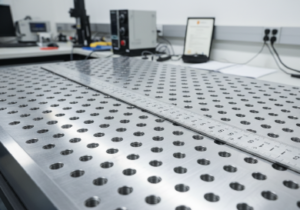
Stress-relieved cast plate. Extremely stable and flat; does not warp during heavy machining. |
Jigs, fixtures, base plates, vacuum tables, precision electronics. |
Jucheng’s Aluminum Machining Capabilities
| Capability |
Technical Description |
Jucheng Advantage |
| 5-Axis Simultaneous Milling |
Utilization of advanced Haas and Mazak 5-axis centers to machine complex contours, impellers, and off-axis features in a single setup. |
Eliminates accumulation errors from re-fixturing; achieves superior geometric dimensioning and tolerancing (GD&T). |
| High-Speed Machining (HSM) |
High RPM spindles (up to 20k RPM) combined with optimized tool paths (trochoidal milling) for rapid material removal rates (MRR). |
Significantly reduces cycle times for large aluminum structural parts, lowering unit costs. |
| Thin-Wall Fabrication |
Specialized strategies to machine walls as thin as 0.5mm, managing vibration and material stress relief to prevent warping. |
Critical for lightweight aerospace and drone components where weight reduction is paramount. |
| Turn-Mill Operations |
Combined lathe and mill functions to produce cylindrical parts with side features like slots, cross-holes, and flats. |
Ensures perfect concentricity and alignment for optical housings and tactical flashlight bodies. |
| Integrated Surface Finishing |
In-house capabilities for bead blasting, cosmetic anodizing (Clear/Black/Gold/Blue/Red), and hard coat anodizing. |
One-stop service ensures faster lead times and strict control over final part aesthetics and durability. |
Fabrication Guidelines for Aluminum
Tooling Selection:
We primarily use solid carbide end mills with high-helix angles (45°) and polished flutes (2 or 3 flutes). This design is crucial for aluminum as it prevents “chip packing” and Built-Up Edge (BUE), ensuring a mirror-like surface finish.
Coolant Strategy:
Aluminum has a high thermal expansion coefficient. We employ high-pressure flood coolant or Through-Spindle Coolant (TSC) systems to evacuate chips instantly and maintain a stable part temperature, ensuring that dimensional tolerances remain consistent throughout the run.
Workholding & Fixturing:
Since aluminum is softer than steel, it is susceptible to deformation under high clamping forces. Jucheng engineers utilize vacuum tables for flat plates and custom-machined soft jaws for complex shapes to distribute holding pressure evenly without marring the surface.
Thread Reinforcement:
Aluminum threads can strip after repeated use. For applications requiring frequent assembly, we recommend and install stainless steel Helicoil inserts or STI (Screw Thread Insert) threads to significantly extend the lifespan of the threaded holes.
Primary Application Industries
Aerospace & Aviation
Key Parts: Wing ribs, bulkhead frames, drone fuselages.
Why Aluminum: The 7075-T6 alloy offers strength comparable to some steels but at a fraction of the weight, critical for fuel efficiency and payload capacity.
Automotive & EV (IATF 16949 Certified)
Key Parts: Battery trays, heat sinks, suspension knuckles, motor housings.
Why Aluminum: Excellent thermal conductivity allows for efficient heat dissipation in electronics and batteries, while lightweighting improves vehicle range.
Medical Devices (ISO 13485 Certified)
Key Parts: MRI components, prosthetics, surgical robot arms, diagnostic equipment chassis.
Why Aluminum: It is non-magnetic (essential for MRI), easy to sterilize, and cost-effective for large structural housings compared to titanium.
Consumer Electronics
Key Parts: High-end camera bodies, audio equipment front panels, laptop enclosures.
Why Aluminum: It accepts cosmetic anodizing extremely well, providing a premium, scratch-resistant surface with a variety of color options.