
+86-188-7042-1176
project@juchengjm.com
Mon-Fri: 8am-6pm (GMT+8)
EN
ISO 9001:2015 Certified
Titanium Grade 2 (CP)
Titanium Grade 2 is the "workhorse" of the Commercially Pure (CP) titanium grades. It offers an excellent balance of strength, ductility, and formability, making it highly versatile. While not as strong as Grade 5 (Ti-6Al-4V), Grade 2 provides superior corrosion resistance in highly oxidizing environments like wet chlorine and seawater. It is also easily weldable. At Jucheng Precision, we machine Grade 2 components for the Chemical, Power Generation, and Marine sectors, employing strict process controls to manage heat build-up and ensure dimensional accuracy in this ductile material.
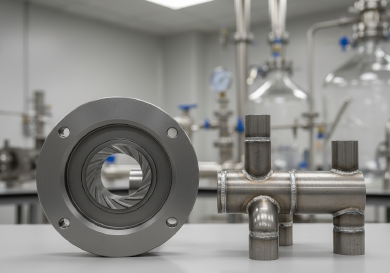
Titanium Grade 2 Machining Capabilities
| Capability | Technical Description | Jucheng Advantage |
|---|---|---|
| Gummy Metal Machining | Grade 2 is softer and “gummites” more than Grade 5. We use sharp, polished carbide inserts to prevent material build-up (BUE). | Our optimized cutting parameters ensure a smooth surface finish without smearing or galling, common issues with pure titanium. |
| Chemical Component Fabrication | Turning and milling flanges, valve bodies, and heat exchanger plates for corrosive environments. | We provide material certifications (Mill Test Reports) ensuring ASTM B348 compliance for critical chemical plants. |
| Precision Welding Prep | Machining precise weld bevels and fit-ups. Grade 2 has excellent weldability compared to alloyed titanium. | We deliver parts ready for clean-room TIG welding, ensuring porosity-free joints for vacuum or pressure vessels. |
| Thin-Wall Turning | Machining thin-walled tubes and housings. | We use specialized workholding to prevent deformation, as Grade 2 is more ductile and prone to flexing than Grade 5. |
Fabrication Guidelines for Titanium Grade 2
Heat Management:
Titanium has very poor thermal conductivity. Heat concentrates at the cutting edge. Tip: High-pressure coolant is mandatory to prevent tool failure and fire hazards (Ti chips are flammable).
Low Cutting Speeds:
To machine Grade 2 successfully, surface speeds must be kept low, but feed rates should be high to cut through the work-hardened layer. Tip: Do not dwell; keep the tool moving.
Tapping Risks:
Tapping Grade 2 is difficult as the material shrinks (“grabs”) onto the tap. Tip: Use thread milling for internal threads whenever possible to avoid broken taps.
Primary Applications
Chemical Processing
Heat exchangers, reaction vessels, and piping systems handling chlorine, chlorides, or nitric acid.
Power Generation
Condenser tubing and cooling water systems in power plants due to immunity to seawater corrosion.
Medical (Non-Load Bearing)
Pacemaker cases and deep-drawn housings where ductility and biocompatibility are required, but high strength is not.
Marine Industry
Desalination equipment and exhaust liners that require absolute resistance to salt spray.
Properties
| Density | 4.51 g/cm³ |
| Tensile Strength | 345 MPa |
| Yield Strength | 275 MPa |
| Hardness | 80 HRB |
| Elongation at Break | 20% |
| Thermal Conductivity | 16.4 W/m-K |
| Electrical Conductivity | 3% IACS |
| Machinability Rating | 46% |
| Weldability | Excellent |
| Corrosion Resistance | Outstanding |
| Biocompatibility | Excellent |
| Max Part Size | 2000 x 800 x 600 mm |