
+86-188-7042-1176
project@juchengjm.com
Mon-Fri: 8am-6pm (GMT+8)
EN
ISO 9001:2015 Certified
Stainless Steel 440C
Stainless Steel 440C is a high-carbon martensitic stainless steel capable of achieving the highest hardness of any standard stainless alloy (up to 60 HRC after heat treatment). Often called "Bearing Steel," it combines the wear resistance of high-carbon tool steel with the corrosion resistance of chromium stainless. It is the material of choice for ball bearings, valve seats, and high-quality cutting tools. At Jucheng Precision, we specialize in the complete manufacturing cycle of 440C: from CNC turning in the annealed state to heat treatment, and finally precision grinding and superfinishing to achieve micron-level tolerances and mirror finishes.
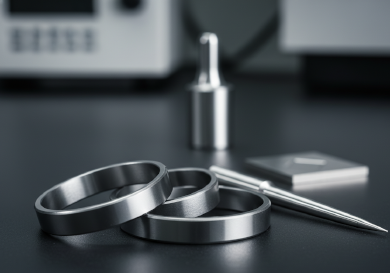
SS 440C Machining Capabilities
| Capability | Technical Description | Jucheng Advantage |
|---|---|---|
| Hard Turning | Turning 440C in its fully hardened state (58-60 HRC) using PCBN (Polycrystalline Cubic Boron Nitride) inserts. | Eliminates the need for grinding on some geometries, reducing cost while maintaining tight tolerances (+/- 0.005mm). |
| Bearing-Grade Grinding | Precision ID/OD grinding to achieve roundness and concentricity within 1 micron. | We produce custom bearing races and rollers that meet ABEC dimensional standards. |
| Cryogenic Treatment | Deep freezing parts after heat treatment to convert retained austenite to martensite. | Ensures maximum dimensional stability and hardness for parts used in precision metrology or aerospace. |
| Superfinishing | Polishing ground surfaces to Ra 0.05µm to reduce friction and wear. | Essential for high-speed shafts and valve seats to prevent seizing and extend service life. |
Fabrication Guidelines for Stainless 440C
Annealed vs. Hardened:
We machine the general shape in the annealed condition (easy to cut) and finish-grind after heat treatment. Tip: Always leave 0.3mm – 0.5mm grinding stock to remove heat-treat distortion.
Corrosion Resistance:
440C has better corrosion resistance than tool steels (like D2) but worse than 304. Tip: Ideally suited for applications involving mild moisture or lubricants, but not saltwater immersion.
Brittleness:
At 60 HRC, 440C is very hard but brittle. Tip: Avoid thin, unsupported walls or sharp internal corners which can crack during quenching.
Primary Applications
Rolling Element Bearings
Balls, rollers, and races. 440C is the standard for corrosion-resistant bearings.
Valve Components
High-pressure valve seats and needle tips that must seal perfectly and resist erosion from fluid flow.
Mold Inserts
Small, high-wear cores in plastic injection molds, especially for abrasive glass-filled plastics.
High-End Cutlery
Premium knife blades and surgical shears requiring the ultimate razor edge retention.
Properties
| Density | 7.80 g/cm³ |
| Tensile Strength | 2030 MPa |
| Yield Strength | 1900 MPa |
| Hardness | 58 - 60 HRC |
| Elongation at Break | 2% |
| Thermal Conductivity | 24.2 W/m-K |
| Electrical Conductivity | 2.5% IACS |
| Machinability Rating | 35% (Annealed) |
| Weldability | Very Poor |
| Corrosion Resistance | Moderate |
| Wear Resistance | Superior |
| Max Part Size | 2000 x 800 x 600 mm |