
+86-188-7042-1176
project@juchengjm.com
Mon-Fri: 8am-6pm (GMT+8)
EN
ISO 9001:2015 Certified
Stainless Steel 304 / 304L
Stainless Steel 304 / 304L is the most versatile and widely used stainless steel in the world, often referred to as "18/8" (18% Chromium, 8% Nickel). It offers excellent corrosion resistance, formability, and weldability, making it superior to 303 for structural and sanitary applications. 304L is the extra-low carbon version, which eliminates harmful carbide precipitation during welding. While tougher to machine than 303 due to its tendency to work-harden, Jucheng Precision employs rigid setups and specialized carbide tooling to machine 304/304L with precision. It is the go-to material for food processing, chemical, and industrial components where durability and hygiene are paramount.
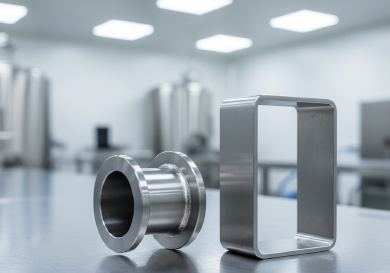
SS 304/304L Machining Capabilities
| Capability | Technical Description | Jucheng Advantage |
|---|---|---|
| Rigid CNC Milling | 304 tends to work-harden if the cutter rubs. We use high-torque spindles and aggressive feed rates to cut efficiently. | Our heavy-duty Mazak machines prevent vibration, ensuring dimensional accuracy even on tough 304 forgings. |
| Sanitary Finishing | Machining parts to Ra 0.8 or better, followed by electropolishing to meet food and medical hygiene standards. | We understand the “surface trap” requirements for sanitary parts, ensuring no crevices for bacteria growth. |
| Welding Prep Machining | Machining precise bevels and grooves on 304L parts to prepare them for TIG/MIG welding. | We provide turnkey manufacturing: CNC machining followed by certified welding services for assemblies. |
| Large Flange Turning | Turning large diameter flanges and rings with tight flatness and seal-groove tolerances. | Our large-swing lathes handle pipe flanges for the oil, gas, and water treatment industries. |
Fabrication Guidelines for Stainless 304
304 vs. 304L:
304L (Low Carbon) is preferred for welded parts to prevent “carbide precipitation” (corrosion at the weld). 304 is standard for non-welded parts. Tip: Most modern stock is “Dual Certified” (304/304L).
Work Hardening Risk:
304 hardens instantly if the tool dwells. Tip: Maintain a constant chip load. Do not let the tool rub. Coolant is mandatory to remove heat.
Passivation:
To ensure maximum corrosion resistance, machined 304 parts should be Passivated (ASTM A967) to remove free iron from the surface.
Primary Applications
Food & Beverage
The industry standard for mixers, valves, and conveyor parts due to resistance to wash-down chemicals and food acids.
Medical Equipment
Hospital carts, surgical trays, and non-implantable devices. Resists sterilization chemicals well.
Industrial Piping
Flanges, fittings, and manifolds for chemical processing and water treatment plants.
Architecture
Outdoor handrails, glass standoffs, and decorative panels that withstand weather without rusting.
Properties
| Density | 8.00 g/cm³ |
| Tensile Strength | 515 MPa |
| Yield Strength | 205 MPa |
| Hardness | 92 HRB |
| Elongation at Break | 40% |
| Thermal Conductivity | 16.2 W/m-K |
| Electrical Conductivity | 2.5% IACS |
| Machinability Rating | 45% |
| Weldability | Excellent |
| Corrosion Resistance | Excellent |
| Magnetic Permeability | Low |
| Max Part Size | 2000 x 800 x 600 mm |