
+86-188-7042-1176
project@juchengjm.com
Mon-Fri: 8am-6pm (GMT+8)
EN
ISO 9001:2015 Certified
Stainless Steel 303
Stainless Steel 303 is the "Free-Machining" grade of the austenitic stainless family. By adding a small amount of sulfur or selenium, the alloy becomes significantly easier to machine than standard 304. The sulfur acts as a chip breaker and lubricant, allowing for faster speeds, longer tool life, and superior surface finishes. While it sacrifices some corrosion resistance and weldability, SS 303 is the most cost-effective choice for high-volume screw machine parts. At Jucheng Precision, we leverage our Swiss-style turning centers to produce millions of precise 303 fasteners, shafts, and bushings annually with exceptional consistency.
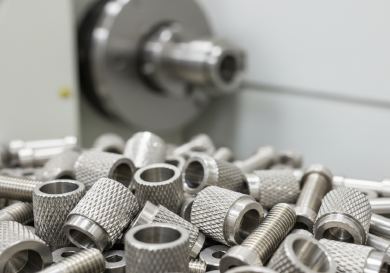
SS 303 Machining Capabilities
| Capability | Technical Description | Jucheng Advantage |
|---|---|---|
| High-Speed Swiss Turning | SS 303 contains sulfur, which acts as a chip breaker. This allows for extremely fast turning speeds compared to 304. | Our Swiss lathes can run 303 parts 24/7 with minimal tool wear, offering the lowest unit cost for stainless components. |
| Complex Knurling | The material’s machinability makes it excellent for forming or cutting diamond knurls without flaking. | We produce tactile knobs and grip surfaces with crisp, defined patterns that are visually perfect. |
| Precision Threading | Tapping and single-point threading are smooth and burr-free due to the brittleness of the chips. | Ideal for manufacturing standoffs, inserts, and custom screws with tight thread tolerances (6g/6H). |
| Deep Hole Drilling | Drilling deep bores is significantly easier in 303 than 304, as chips evacuate easily without jamming. | We can drill high aspect ratio holes for fluid nozzles and sensor housings efficiently. |
Fabrication Guidelines for Stainless 303
Corrosion Trade-off:
The added sulfur improves machinability but lowers corrosion resistance compared to 304. Tip: Do not use 303 for marine environments or pressurized gas containment where micro-porosity from sulfur could be an issue.
Do Not Weld:
303 is generally considered non-weldable. The sulfur content causes “hot cracking” during welding. Tip: Design assemblies to be bolted or pressed, not welded.
Passivation Care:
Passivating 303 requires careful chemistry control (often Citric acid based) to avoid etching the sulfur inclusions, which can turn the part black (“frosting”).
Primary Applications
Fasteners & Hardware
Nuts, bolts, screws, and standoffs that require the look and feel of stainless but need to be produced cheaply in high volumes.
Electrical Components
Connectors, terminals, and switchgear housings where non-magnetic properties (annealed) and precision are needed.
Industrial Bushings
Moving parts requiring decent wear resistance and preventing seizing (galling) which is more common in 304/316.
Automotive fittings
Sensor bodies and interior trim parts that are not exposed to road salt.
Properties
| Density | 7.90 g/cm³ |
| Tensile Strength | 620 MPa |
| Yield Strength | 241 MPa |
| Hardness | 85 HRB |
| Elongation at Break | 35% |
| Thermal Conductivity | 16.2 W/m-K |
| Electrical Conductivity | 2.5% IACS |
| Machinability Rating | 78% |
| Weldability | Poor |
| Corrosion Resistance | Good |
| Magnetic Permeability | Low |
| Max Part Size | 2000 x 800 x 600 mm |