
+86-188-7042-1176
project@juchengjm.com
Mon-Fri: 8am-6pm (GMT+8)
EN
ISO 9001:2015 Certified
Aluminum 7075-T6 / T651
Aluminum 7075-T6 / T651 is often referred to as "Aircraft Grade Aluminum" and is one of the strongest aluminum alloys available. With Zinc as its primary alloying element, it offers mechanical strength comparable to many steels but at one-third the weight. The "T6" temper provides maximum tensile strength, while T651 offers stress-relieved plates for superior dimensional stability during machining. At Jucheng Precision, we specialize in machining complex 7075 components for the Aerospace and Defense industries. Our rigorous process control ensures that the material's high hardness is utilized to produce parts with exceptional surface finishes and tight tolerances (+/- 0.005mm), suitable for high-stress applications like gears, shafts, and climbing equipment.
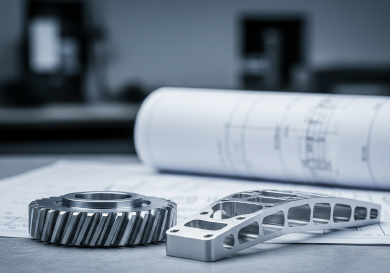
7075-T6 Machining Capabilities
| Capability | Technical Description | Jucheng Advantage |
|---|---|---|
| High-Precision Milling | 7075 is harder than 6061, resulting in better chip breaking and superior surface finishes directly off the machine. | We achieve mirror-like finishes (Ra 0.4) on 7075 parts without manual polishing, ideal for cosmetic aerospace components. |
| Thin-Wall Structural Parts | Due to its high strength, 7075 can be machined into very thin walls (0.5mm) without collapsing or bending. | Our 5-axis machines utilize adaptive tool paths to maintain rigidity while removing up to 90% of the material for lightweighting. |
| Complex Gear Machining | Machining intricate gears and splines that require high fatigue strength and wear resistance. | We use specialized gear hobbing and 4-axis milling strategies to produce 7075 gears that rival steel in strength-to-weight ratio. |
| Stress-Relieved Milling | Using 7075-T651 plate to minimize movement during heavy hogging operations. | Guarantees flatness on large aircraft bulkheads and mold bases. |
Fabrication Guidelines for 7075 Aluminum
Weldability Warning:
Unlike 6061, 7075 is generally considered non-weldable (prone to micro-cracking). Tip: Parts should be designed as single-piece machined components or fastened/bonded rather than welded.
Anodizing Considerations:
7075 contains high amounts of Zinc. While it can be anodized, Clear Anodizing may result in a slightly yellowish tint compared to the silver of 6061. Hard Anodizing (Type III) works excellent for wear resistance.
Corrosion Resistance:
7075 has lower corrosion resistance than 6061. Tip: For outdoor or marine use, a protective coating (Anodizing, Chem Film/Alodine, or Paint) is mandatory to prevent stress-corrosion cracking.
Primary Applications
Aerospace & Aviation
The primary alloy for aircraft wing structures, fuselages, and gears due to its immense strength comparable to some steels.
High-Performance Sports Equipment
Rock climbing carabiners, bicycle frames, and gears where weight reduction is critical but failure is not an option.
Mold Making
Used for prototype injection molds and blow molds. It is hard enough to withstand injection pressures but machines much faster than tool steel.
Defense & Firearms
Tactical receivers, buffer tubes, and precision optics mounts requiring rigidity and durability.
Properties
| Density | 2.81 g/cm³ |
| Tensile Strength | 572 MPa |
| Yield Strength | 503 MPa |
| Hardness | 150 HB (Brinell) |
| Elongation at Break | 11% |
| Thermal Conductivity | 130 W/m-K |
| Electrical Conductivity | 33% IACS |
| Fatigue Strength | 159 MPa |
| Machinability Rating | Fair to Good |
| Weldability | Poor |
| Max Part Size | 2000 x 800 x 600 mm |