
+86-188-7042-1176
project@juchengjm.com
Mon-Fri: 8am-6pm (GMT+8)
EN
ISO 9001:2015 Certified
Aluminum 6061-T6 / T651
Aluminum 6061-T6 / T651 is the most versatile and widely used aluminum alloy in the CNC machining industry. It offers an exceptional balance of mechanical strength, corrosion resistance, and workability. The "T6" temper indicates the material has been solution heat-treated and artificially aged for maximum hardness. The "T651" variant is specifically stress-relieved by stretching, making it the superior choice for machining large, flat parts where minimizing warpage is critical. At Jucheng Precision, we stock premium 6061-T651 blocks and bars to ensure your structural components and electronic housings hold tight tolerances (+/- 0.01mm) and achieve a flawless finish after anodizing.
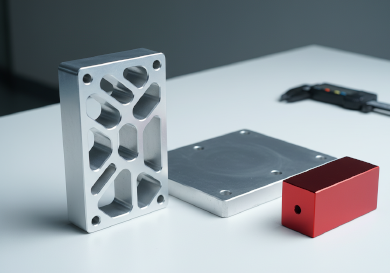
6061-T6 Machining Capabilities
| Capability | Technical Description | Jucheng Advantage |
|---|---|---|
| High-Speed 5-Axis Milling | 6061-T6 allows for high material removal rates (MRR) without sticking. We utilize 20,000 RPM spindles for rapid roughing and finishing. | Our Haas/Mazak 5-axis centers reduce setup times for complex 6061 manifolds and brackets, ensuring geometric accuracy. |
| Stress-Relieved Machining (T651) | Using 6061-T651 plates (mechanically stretched) to prevent warping during heavy material removal. | Essential for large flat panels and optical breadboards where flatness tolerances (< 0.05mm) are critical. |
| Complex Turning | Turning threads, flanges, and internal bores with excellent chip control. | We achieve mirror-like turned finishes on 6061 parts, often eliminating the need for post-polishing. |
| Anodizing Prep | CNC machining with surface finish optimization (Ra 0.8) specifically for subsequent anodizing. | Jucheng ensures tool marks are minimized so the final anodized color (Type II/III) is uniform and defect-free. |
Fabrication Guidelines for 6061 Aluminum
Weldability:
6061 is highly weldable (TIG/MIG). However, welding reduces strength in the heat-affected zone (HAZ). Tip: If high strength is needed after welding, the part may need re-heat treatment/aging.
Anodizing Response:
This grade is the industry standard for anodizing. It accepts dyes (Black, Red, Blue, Gold) perfectly. Tip: For cosmetic parts, 6061 is superior to 7075, which can sometimes turn yellowish or uneven during clear anodizing.
Corrosion Resistance:
Excellent atmospheric corrosion resistance. Tip: For marine environments, 5052 is better, but 6061 with a Hard Anodize (Type III) coating is a very strong alternative.
Primary Applications
Automotive Parts (IATF 16949)
Used for ABS brake manifolds, suspension arms, and chassis brackets due to its good strength-to-weight ratio.
Electronics Enclosures
Custom machined housings for heat dissipation. 6061’s thermal conductivity makes it an effective heat sink material.
Structural Frames
Robot arms, drone frames, and bicycle components where stiffness and weldability are required.
Jigs & Fixtures
The T651 temper is the standard material for manufacturing base plates and inspection fixtures due to its stability.
Properties
| Density | 2.70 g/cm³ |
| Tensile Strength | 310 MPa |
| Yield Strength | 276 MPa |
| Hardness | 95 HB |
| Elongation at Break | 12 - 17 % |
| Thermal Conductivity | 167 W/m-K |
| Electrical Conductivity | 40 - 50 % IACS |
| Fatigue Strength | 96 MPa |
| Machinability Rating | Good - |
| Weldability | Excellent - |
| Max Part Size | 2000 x 800 x 600 mm |