
+86-188-7042-1176
project@juchengjm.com
Mon-Fri: 8am-6pm (GMT+8)
EN
ISO 9001:2015 Certified
Aluminum 2024-T3 / T4
Aluminum 2024-T3 / T4 is the primary "Aircraft Alloy." It is a high-strength aluminum-copper alloy known for its excellent fatigue resistance, making it the material of choice for structural components subject to tension. While it offers strength comparable to 7075, 2024 excels in applications where cyclic loading (vibration/stress) is a concern. However, its high copper content makes it less corrosion-resistant than 6061. At Jucheng Precision, we understand the critical nature of aerospace machining. We machine 2024-T3 with strict attention to surface finish to prevent stress risers and offer comprehensive post-processing (like Anodizing or Chem Film) to ensure your parts meet flight-ready standards.
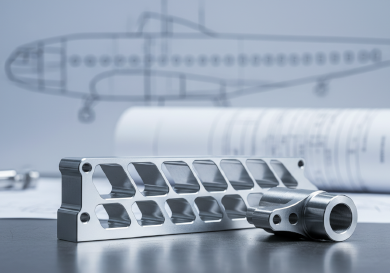
2024-T3 Machining Capabilities
| Capability | Technical Description | Jucheng Advantage |
|---|---|---|
| High Fatigue Machining | Machining critical structural parts that must withstand cyclic loading without cracking. | We use optimized tool paths to avoid creating surface stress risers, ensuring maximum fatigue life for aerospace fittings. |
| Precision Hole Making | Drilling and reaming holes for fasteners (rivets/bolts) with tight tolerance (H7) and positional accuracy. | Crucial for aircraft assembly. Our CNC centers hold hole positions to +/- 0.01mm across large bulkheads. |
| Surface Protection Prep | 2024 has poor corrosion resistance. We machine parts to be immediately ready for Alodine (Chem Film) or Cladding. | We coordinate post-processing to ensure parts are coated before oxidation begins, meeting Mil-Spec standards. |
| Complex Pocketing | Deep pocket milling to reduce weight while maintaining structural integrity. | Our high-speed spindles remove material efficiently while maintaining thin wall stability (down to 1mm). |
Fabrication Guidelines for 2024 Aluminum
Corrosion Sensitivity:
2024 contains high Copper (4.4%), making it susceptible to corrosion. Tip: It is almost always anodized or chemically conversion coated (Alodine). “Alclad” sheets (pure aluminum coated) are often used for skins.
Machinability:
2024 machines very well (better finish than 6061) producing small chips. However, the copper content can be abrasive to tools. Tip: Use sharp carbide tools and flood coolant.
Weldability:
Not recommended for welding. Welding causes hot cracking and significantly reduces corrosion resistance. Tip: Use fasteners (rivets/bolts) for assembly instead.
Primary Applications
Aircraft Structures
Fuselage skins, wing tension members, and bulkheads where high tensile strength and fatigue resistance are paramount.
Precision Fittings
Hydraulic manifolds and valve bodies within the aviation sector.
High-Stress Parts
Gears and shafts in machinery where weight savings over steel are required but 6061 is not strong enough.
Scientific Instruments
Orthopedic braces and veterinary equipment requiring stiff, lightweight frames.
Properties
| Density | 2.78 g/cm³ |
| Tensile Strength | 483 MPa |
| Yield Strength | 345 MPa |
| Hardness | 120 HB (Brinell) |
| Elongation at Break | 18% |
| Thermal Conductivity | 121 W/m-K |
| Electrical Conductivity | 30% IACS |
| Fatigue Strength | 138 MPa |
| Machinability Rating | Good |
| Weldability | Poor |
| Corrosion Resistance | Poor |
| Max Part Size | 2000 x 800 x 600 mm |