
+86-188-7042-1176
project@jcproto.com
Mon-Fri: 8am-6pm (GMT+8)
EN
ISO 9001:2015 Certified
Polishing
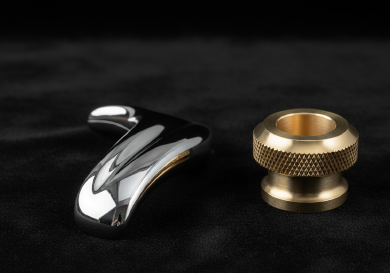
Polishing is a subtractive finishing process used to smooth a part’s surface, remove tool marks, and enhance its aesthetic appeal or functional performance (such as reducing friction or sealing capabilities). At Jucheng Precision, we offer everything from basic brushing to Ra 0.05µm Mirror Polishing.
We combine skilled manual craftsmanship for complex geometries with automated vibratory finishing for high-volume orders. Our capabilities extend beyond metals; we also specialize in Vapor Polishing for optical plastics (PC/Acrylic) and Electropolishing for medical and semiconductor components requiring ultra-clean surfaces.
Key Specifications
| Specification | Technical Range | Note |
|---|---|---|
| Surface Roughness (Ra) | Down to 0.05 µm (2 micro-inch) | Mirror finish level |
| Max Part Size | 1000 mm x 600 mm x 500 mm | Manual buffing capacity |
| Dimensional Change | -0.005mm to -0.05mm | Depends on starting roughness |
| Materials | Stainless, Al, Brass, Ti, Plastics | Hard metals take longer |
| Gloss Level | Satin to Mirror (No. 8 Finish) | Customizable |
| Standard Lead Time | 2 – 5 Days | Labor intensive process |
Polishing Methods
| Method | Description | Key Benefits & Applications |
|---|---|---|
| Mechanical Buffing | Using polishing wheels with abrasive compounds (rouges) to physically smooth the metal surface progressively. | Benefit: Creates a true mirror reflection (No. 8 finish). App: Decorative trim, luxury goods, mold cavities. |
| Electropolishing | An electrochemical process that removes surface ions. “Reverse plating.” Preferentially attacks peaks to smooth the surface. | Benefit: Microsmooth surface, deburrs edges, improves corrosion resistance. App: Medical instruments, food processing, vacuum chambers. |
| Vapor Polishing | Exposing plastics (PC, Ultem, Acrylic) to chemical vapors that melt the surface layer to transparency. | Benefit: Clarifies internal channels that cannot be reached by hand. App: Optical lenses, fluid manifolds, medical reservoirs. |
| Brushing / Satin | Using abrasive belts (Scotch-Brite) to create a directional grain pattern (like hairline finish). | Benefit: Hides fingerprints and scratches. App: Appliance panels, architectural fittings. |
Design Guidelines for Polishing
Edge Rounding:
Aggressive buffing will naturally round off sharp edges and corners. Tip: If you need a crisp, sharp edge (e.g., a sealing face), specify “Mask during polishing” or allow for a small radius.
Material Removal:
To remove deep CNC tool marks, we must remove material down to the bottom of the deepest scratch. This can affect dimensional tolerances by 0.01-0.03mm. Tip: Machine critical features slightly oversize to account for this.
Access Restrictions:
Mechanical wheels cannot reach into sharp internal corners or deep, narrow slots. These areas will remain “as-machined” or require expensive manual hand-working. Tip: Design with large internal radii.
Surface Consistency:
Large flat surfaces are the most difficult to polish perfectly without waviness or “orange peel.” Tip: A brushed or matte finish is more forgiving for large flat areas than a mirror finish.
Industry Applications
Mold Making
Plastic injection molds require SPI A-1 diamond polishing to ensure the plastic part releases easily and has a glossy finish.
Medical (ISO 13485)
Surgical implants and tools are electropolished to remove microscopic crevices where bacteria could hide, making them easier to sterilize.
Automotive
Exhaust tips, rim details, and interior aluminum trim are buffed to a high gloss for showroom appeal.
Semiconductor
Vacuum chambers and gas lines are electropolished to minimize surface area and outgassing, ensuring an ultra-high vacuum environment.