
+86-188-7042-1176
project@jcproto.com
Mon-Fri: 8am-6pm (GMT+8)
EN
ISO 9001:2015 Certified
Anodizing
Anodizing is an electrochemical process that converts the metal surface into a durable, corrosion-resistant, and anodic oxide finish. Unlike painting or plating, the anodic layer is integrated with the underlying aluminum substrate, meaning it cannot chip or peel. At Jucheng Precision, we offer Anodizing as a critical part of our one-stop manufacturing solutions.
We strictly adhere to international standards like Mil-A-8625, ensuring uniform thickness and consistent color matching across batches. Whether you need vibrant cosmetic finishes for consumer electronics or wear-resistant Hardcoat (Type III) for robotic components, our integrated supply chain allows us to deliver fully finished parts with lead times as short as 3-5 days post-machining.
Key Specifications
| Specification | Technical Range | Note |
|---|---|---|
| Max Part Size | 2000 mm x 1000 mm x 600 mm | Suitable for large plates & frames |
| Standard Thickness (Type II) | 5 – 25 µm (0.0002″ – 0.001″) | Decorative & Corrosion Resistance |
| Standard Thickness (Type III) | 25 – 75+ µm (0.001″ – 0.003″) | High Wear Resistance (Hardcoat) |
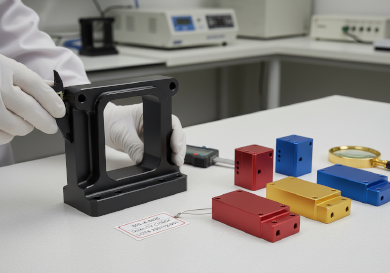
| Color Options | Black, Clear, Red, Blue, Gold, Grey | Custom colors available (Pantone match) |
| Surface Hardness (Type III) | 60 – 70 Rockwell C | Comparable to hard steel |
| Compatible Materials | Aluminum (6xxx, 7xxx, 5xxx series) | 2xxx series is difficult to anodize |
| Applicable Standard | Mil-A-8625 Type II & III | Military Spec Compliance |
Anodizing Process Types
| Type | Description | Key Benefits & Applications |
|---|---|---|
| Type II (Sulfuric) | “Standard” or “Decorative” anodizing. The most common form used for general corrosion protection and coloration. | Benefit: Wide variety of colors, good corrosion resistance, cost-effective. App: Electronic enclosures, brackets, automotive trim. |
| Type III (Hardcoat) | Performed at lower temperatures and higher voltages to create a denser, thicker oxide layer. Usually dark grey or black. | Benefit: Extreme wear resistance, non-conductive, harder surface. App: Gears, sliding mechanisms, aerospace valves, firearms. |
| Bead Blast + Anodize | Parts are sandblasted (glass beads) before anodizing to remove tool marks and create a uniform matte finish. | Benefit: Hides machining marks, premium non-reflective look. App: High-end consumer audio, tactical equipment. |
| Clear Anodize | Anodizing without adding dye. Protects the aluminum while retaining its natural metallic silver appearance. | Benefit: Prevents oxidation/tarnishing while looking like raw metal. App: Medical frames, structural components. |
Design Guidelines for Anodizing
Dimensional Growth:
Anodizing adds thickness. For Type II, the growth is minimal (~50% of total thickness grows outward), but for Type III Hardcoat, it can add up to 25µm (0.001″) per side. Tip: Designers must account for this “buildup” in critical holes or threaded features, or request masking.
Material Selection:
Best: 6061 Aluminum is the industry standard and accepts color perfectly.
Good: 7075 Aluminum is stronger but can result in a slightly yellowish tint when clear anodized.
Avoid: 2024 Aluminum (high copper content) is difficult to anodize and often looks “muddy” or splotchy.
Racking Marks:
Parts must be physically held (racked) to pass electrical current. This leaves tiny bare spots (contact points) where the anodizing won’t form. Tip: Specify where racking marks are acceptable (e.g., inside a bore or on a non-cosmetic back face).
Color Matching:
Unlike paint, anodizing dye interacts with the metal’s grain structure. Slight color variations can occur between batches. For strict consistency, we recommend processing all parts of an assembly in the same batch.
Industry Applications
Consumer Electronics
Used extensively for smartphone bodies, laptop chassis, and camera housings to provide a premium, scratch-resistant colorful finish.
Aerospace & Defense
Type III Hardcoat is standard for internal aircraft components, actuators, and military optical housings to withstand extreme wear and salt-spray environments.
Medical Devices
Titanium and Aluminum anodizing allows for color-coding of surgical instruments (e.g., matching drills to screws) and provides a sterilization-resistant surface.
Industrial Automation
Robotic arms, base plates, and structural framing are often black anodized to prevent corrosion and reduce light reflection in vision systems.