
+86-188-7042-1176
project@jcproto.com
Mon-Fri: 8am-6pm (GMT+8)
EN
ISO 9001:2015 Certified
Virgin PTFE
Virgin PTFE (Polytetrafluoroethylene) is the highest purity grade of Teflon, renowned for its near-universal chemical resistance and the lowest coefficient of friction of any solid material. Capable of operating from -200°C to +260°C, it is an essential material for high-performance seals, medical fluidics, and electrical insulators. Jucheng Precision specializes in the precision CNC machining of this exceptionally soft polymer, utilizing ultra-sharp tooling and specialized workholding to overcome challenges like material creep and high thermal expansion. Whether you need complex gas-tight seals or FDA-compliant medical manifolds, our expertise ensures your PTFE parts are delivered with burr-free edges and the precise dimensions required for critical industrial assemblies.
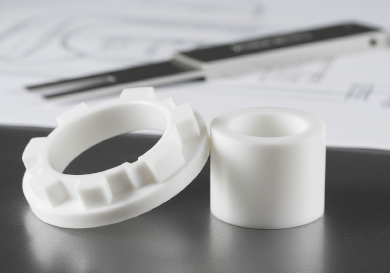
PTFE / Teflon Material Variants
| Grade | Common Name | Key Characteristics | Typical Applications |
|---|---|---|---|
| Virgin PTFE | Electrical Grade | 99.9% Pure. Lowest friction, highest chemical resistance, and best dielectric properties. FDA compliant. | Chemical seals, medical components, laboratory fluidics, electrical insulators. |
| Mechanical PTFE | Reprocessed PTFE | Contains recycled material. Lower cost but reduced mechanical and electrical properties. Not for food use. | Non-critical spacers, washers, wear pads. |
| Glass-Filled PTFE | 15% / 25% GF PTFE | Reinforced with glass fibers to reduce “cold flow” (creep) and improve compressive strength. | Valve seats, gaskets, high-pressure bearings. |
| Bronze-Filled PTFE | Bearing Grade | Added bronze powder for superior wear resistance and thermal conductivity. Best for heavy loads. | Hydraulic cylinder guides, dynamic seals, slider plates. |
Virgin PTFE Machining Capabilities
| Capability | Technical Description | Jucheng Advantage |
|---|---|---|
| Precision Seal Turning | Machining intricate lip profiles and fine grooves for high-performance hydraulic and pneumatic seals. | We achieve burr-free edges and Ra 0.4μm finishes directly off the tool, critical for gas-tight and vacuum-tight sealing integrity. |
| Thin-Wall Sleeve Machining | Boring and turning thin-walled PTFE liners and sleeves (down to 0.5mm) without material tearing. | Using specialized air-chucks and internal mandrels, we prevent the deformation of the soft PTFE, ensuring perfect concentricity. |
| Zero-Burr Micro-Drilling | Drilling micro-channels in PTFE blocks for laboratory fluidic manifolds and chemical analyzers. | Our ultra-sharp micro-tooling ensures internal channels are smooth and free of the stringy burrs common when machining soft Teflon. |
| Dimensional Stability Control | Managing the high thermal expansion of PTFE during the machining process to hold tight tolerances. | We machine in a climate-controlled facility and utilize specific “dwell periods” to ensure the part reaches thermal equilibrium before final sizing. |
Fabrication Guidelines for Virgin PTFE
Clamping Sensitivity:
PTFE is extremely soft and prone to “cold flow” (permanent deformation under pressure). Tip: We use custom soft jaws that encapsulate the part or vacuum workholding to prevent clamping marks and geometry distortion.
Thermal Expansion Awareness:
PTFE has a massive coefficient of thermal expansion and undergoes a phase change at 19°C. Tip: We maintain a stable 20°C environment for machining and inspection to ensure dimensions remain consistent from our factory to your assembly line.
Sharp Tooling Strategy:
Dull tools will push and smear the material rather than cut it. Tip: We use high-rake, polished uncoated carbide tools. This ensures the PTFE is sheared cleanly, resulting in the best possible surface finish and dimensional accuracy.
Stress Relief:
Large PTFE billets often contain internal stress from the extrusion process. Tip: We perform roughing passes followed by a stabilizing period to allow the material to “relax” before performing final critical finish passes.
Primary Applications
Chemical & Fluid Handling
Valve seats, pump diaphragms, and gaskets that require near-universal chemical r
Properties
| Density | 2.14 - 2.18 g/cm³ |
| Tensile Strength | 20 - 35 MPa |
| Coefficient of Friction | 0.05 - 0.10 |
| Hardness | 55 - 65 Shore D |
| Elongation at Break | 250 - 450% |
| Thermal Conductivity | 0.25 W/m-K |
| Continuous Service Temp | -200 to +260 °C |
| Water Absorption | < 0.01% |
| Dielectric Strength | 20 - 60 kV/mm |
| Machinability Rating | Moderate |
| Max Part Size | 2000 x 800 x 600 mm |