
+86-188-7042-1176
project@jcproto.com
Mon-Fri: 8am-6pm (GMT+8)
EN
ISO 9001:2015 Certified
General Purpose ABS
General Purpose ABS is the industry standard for functional prototyping and low-volume manufacturing. Known for its excellent impact resistance, ease of machining, and superb post-processing versatility, it allows for the rapid creation of complex housings with integrated snap-fits. Jucheng Precision specializes in the CNC machining of ABS, providing high-fidelity prototypes that mimic the look and feel of final injection-molded parts. Our ability to sand, paint, and chemically bond ABS components makes it the premier choice for designers requiring "show-ready" models and robust enclosures for the consumer electronics and automotive sectors.
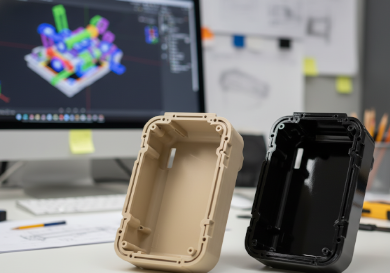
ABS Material Variants
| Grade | Common Name | Key Characteristics | Typical Applications |
|---|---|---|---|
| Standard ABS | General Purpose (GP) | Outstanding impact resistance and ease of machining. Best for cost-effective prototyping. | Consumer electronics, toys, automotive trim, enclosures. |
| Flame Retardant ABS | ABS-FR (UL94 V-0) | Formulated to resist combustion. Essential for regulated electronic components. | Power supply housings, network equipment, appliances. |
| PC-ABS Alloy | Polycarbonate/ABS | Combines ABS’s processability with PC’s high heat resistance and strength. | Automotive dashboards, rugged handheld devices. |
| Transparent ABS | MABS | Provides clear visibility (though slightly lower clarity than PC or Acrylic). | Medical fluid containers, indicator lenses. |
General Purpose ABS Machining Capabilities
| Capability | Technical Description | Jucheng Advantage |
|---|---|---|
| Rapid Prototyping Milling | High-speed milling of complex housings and ergonomic shapes directly from CAD data. | We deliver functional ABS prototypes in as little as 3 days, allowing for rapid design iteration and testing. |
| Intricate Snap-Fit Machining | Machining delicate snap-latch features that require precise elasticity and tolerance control. | Our 5-axis machines ensure perfect alignment of mating parts, delivering a “production-feel” click and secure retention. |
| Comprehensive Surface Finishing | Integrated secondary services including sanding, priming, and automotive-grade painting. | We provide “show-ready” components with textured or high-gloss finishes that are indistinguishable from injection molded parts. |
| Solvent Bonding & Assembly | Using chemical bonding to create large or multi-part ABS assemblies without visible seams. | Jucheng offers complete assembly services, combining multiple machined sections into single, robust structural units. |
Fabrication Guidelines for General Purpose ABS
Thermal Sensitivity:
ABS has a relatively low melting point. Tip: We use high-speed spindles with moderate feed rates and air-cooling to prevent the material from softening and “gumming” the cutting tool.
Tooling Sharpness:
ABS is ductile and can leave a “fuzzy” edge if the tool is dull. Tip: We utilize ultra-sharp, uncoated carbide tools to ensure clean, crisp edges and burr-free internal features.
Workholding Flexibility:
Being a lightweight plastic, ABS is prone to vibration during heavy milling. Tip: We use custom vacuum fixtures or low-pressure clamping to secure thin-walled sections without causing deformation.
Post-Processing Excellence:
ABS is one of the best plastics for sanding and painting. Tip: Its compatibility with various coatings makes it the premier choice for prototypes that require a specific aesthetic or texture.
Primary Applications
Consumer Electronics
Housings for remote controls, smartphones, and wearable device prototypes where fit and finish are critical.
Automotive Interiors
Machined dashboard components, vent louvers, and trim panels used for ergonomic testing and design validation.
Medical Device Prototypes
Non-clinical device enclosures and handheld scanner bodies requiring impact resistance and a professional finish.
Product Development
Scale models and functional assemblies used for investor pitches, trade shows, and mechanical proof-of-concept testing.
Properties
| Density | 1.05 g/cm³ |
| Tensile Strength | 40 - 50 MPa |
| Elastic Modulus | 2.0 - 2.5 GPa |
| Hardness | 110 Rockwell R |
| Impact Strength | 200 - 350 J/m |
| Heat Deflection Temp | 85 - 95 °C |
| Continuous Service Temp | 70 - 80 °C |
| Water Absorption | 0.30% |
| Dielectric Strength | 15 - 20 kV/mm |
| Machinability Rating | Excellent |
| Max Part Size | 2000 x 800 x 600 mm |